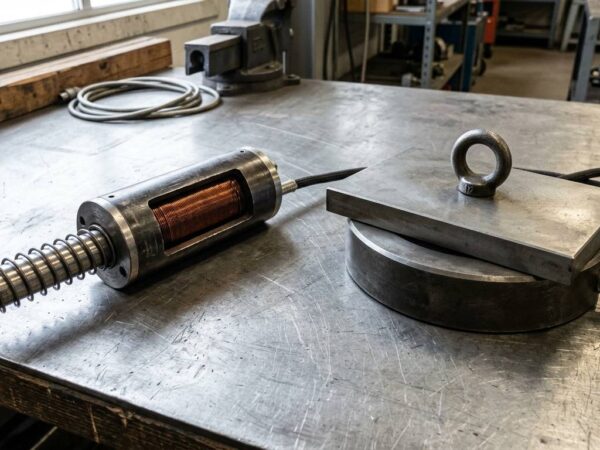
AC Laminated Solenoid Operating Characteristics Analysis: Why Silicon Steel Laminations Are Essential, Zero-Crossing Shading Coils, Inrush Current, and High-Force Application Scenarios

In heavy-duty industrial automation, stamping press interlocking mechanisms, high-pressure valve actuation, and large-scale conveyor sorting systems, the laminated AC solenoid serves as an irreplaceable prime mover. Unlike DC solenoids that…
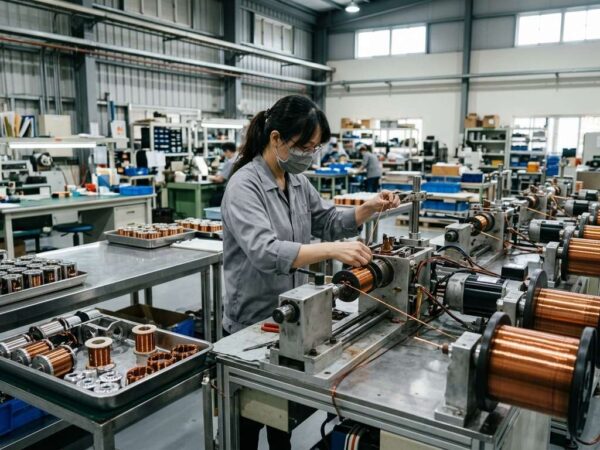
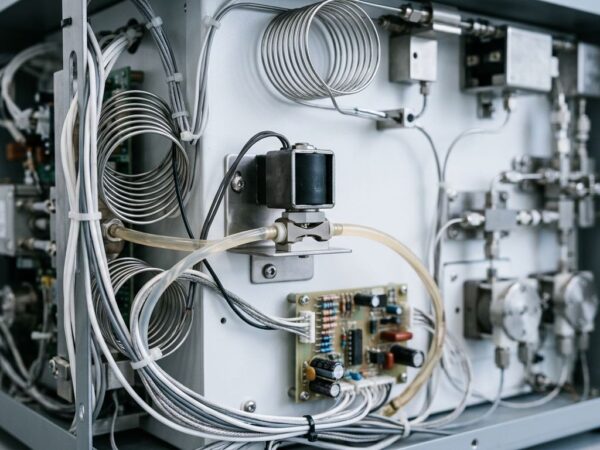
Continue ReadingAC Laminated Solenoid Operating Characteristics Analysis: Why Silicon Steel Laminations Are Essential, Zero-Crossing Shading Coils, Inrush Current, and High-Force Application Scenarios

Procurement Essentials for Automotive Linear Solenoid Valves and Actuators: Key Validation Factors for Vibration, Shock, and Wide Operating Temperature (-40°C to 125°C)

In New Energy Vehicles (NEVs), Advanced Driver Assistance Systems (ADAS), and intelligent chassis electronic control systems, Automotive Linear Solenoid Valves and electromagnetic actuators undertake critical responsibilities such as transmission hydraulic…

Continue ReadingProcurement Essentials for Automotive Linear Solenoid Valves and Actuators: Key Validation Factors for Vibration, Shock, and Wide Operating Temperature (-40°C to 125°C)

Latching Actuator Selection for Portable Medical Diagnostic Instruments: Engineering Considerations for Zero-Power Holding and Low Electromagnetic Interference (EMI)

With the rapid growth of Point-of-Care Testing (POCT), handheld blood gas analyzers, and portable microfluidic molecular diagnostic devices, medical equipment is advancing toward lightweight designs, battery-powered operation, and high sensitivity.…

Continue ReadingLatching Actuator Selection for Portable Medical Diagnostic Instruments: Engineering Considerations for Zero-Power Holding and Low Electromagnetic Interference (EMI)

Tubular vs. Open Frame Solenoids: Evaluation of Magnetic Circuit Enclosure, Force Curves, and Heat Dissipation Efficiency

During the specification definition and procurement decision-making process for automation equipment and precision electromechanical projects, one of the most common hardware selection challenges faced by mechanical engineers and procurement managers…

Continue ReadingTubular vs. Open Frame Solenoids: Evaluation of Magnetic Circuit Enclosure, Force Curves, and Heat Dissipation Efficiency

Solenoid Selection for Battery-Powered and IoT Devices: How to Achieve Over 10 kg Holding Force with an Ultra-Short 50ms Pulse

In smart water meters, remote gas valves, outdoor environmental monitoring nodes, and various Narrowband IoT (NB-IoT / Cat-M1) devices, hardware architects often face a severe engineering contradiction: "The system is…

Continue ReadingSolenoid Selection for Battery-Powered and IoT Devices: How to Achieve Over 10 kg Holding Force with an Ultra-Short 50ms Pulse

Smart Logistics and Unattended Locker Solenoid Lock Selection Guide: Vandal Resistance, Microswitch Signal Feedback, and Emergency Unlocking Mechanisms

In unattended scenarios such as smart express lockers, fresh food pickup lockers, gym lockers, and factory smart asset management cabinets, hardware systems must operate at high frequency year-round in unmanned…

Continue ReadingSmart Logistics and Unattended Locker Solenoid Lock Selection Guide: Vandal Resistance, Microswitch Signal Feedback, and Emergency Unlocking Mechanisms

Demagnetization Time and Residual Magnetism Elimination in Latching Solenoids: 3 Critical Mechanical Factors Affecting Microsecond-Level High-Speed Release

In high-cycle-rate actuation systems such as high-speed automated production lines, semiconductor sorting equipment, and optical inspection shutters, mechanical actuation frequencies often reach dozens of cycles per second. While adopting latching…

Continue ReadingDemagnetization Time and Residual Magnetism Elimination in Latching Solenoids: 3 Critical Mechanical Factors Affecting Microsecond-Level High-Speed Release

Monostable vs. Bistable Latching Solenoids: Working Principles, Driver Topologies, and Project Selection Guide

In the development of automation equipment, smart access control, smart parcel lockers, and various industrial IoT mechanisms, actuator selection directly impacts system power consumption, control complexity, and safety during emergency…

Continue ReadingMonostable vs. Bistable Latching Solenoids: Working Principles, Driver Topologies, and Project Selection Guide

How to Understand Solenoid Certifications: UL, IATF, CE, and RoHS Are Four Different Requirements

  • Post published:
  • Post category:Technical Hub
  • Post last modified:
  • Reading time:11 mins read

One is a third-party safety certification, one certifies a management system, one is a self-declared conformity marking, one is a materials restriction. Knowing which is which changes what you should ask a supplier for.

Continue ReadingHow to Understand Solenoid Certifications: UL, IATF, CE, and RoHS Are Four Different Requirements

Difference Between Solenoids and Contactors: One Switches Power, One Creates Motion—How to Tell Them Apart

A contactor is a relay scaled for motor loads, with arc chutes and utilisation categories, and it closes its contacts with a solenoid of its own. Neither substitutes for the other; in most panels they sit in series.

Continue ReadingDifference Between Solenoids and Contactors: One Switches Power, One Creates Motion—How to Tell Them Apart