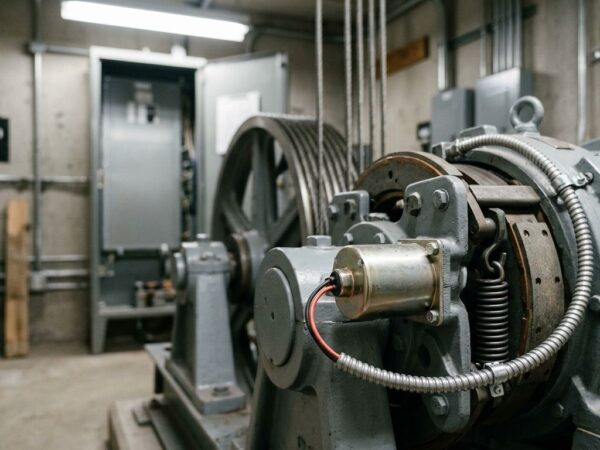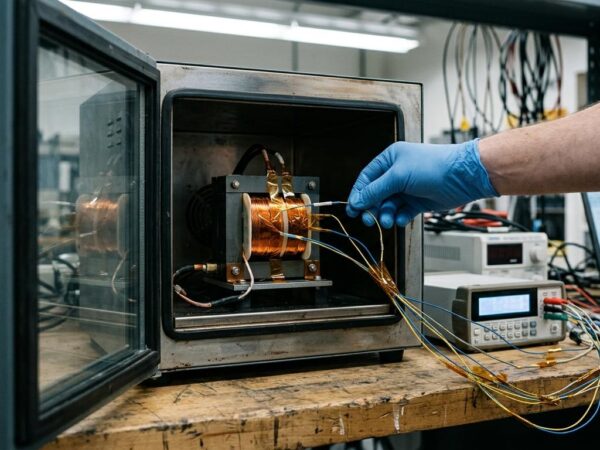
How to Choose Laboratory Solenoids: Four Side Effects Determine Success, While Force Is Not the Priority

In analytical instruments the forces are small and easy to meet. Heat, vibration, stray magnetic field and particle generation are what decide the selection, because each of them perturbs the measurement itself.
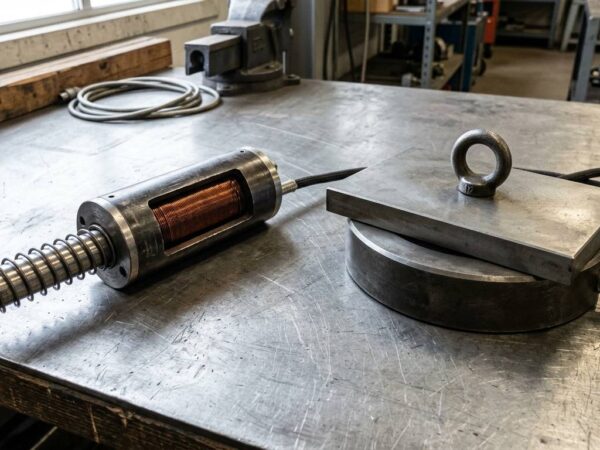
Continue ReadingHow to Choose Laboratory Solenoids: Four Side Effects Determine Success, While Force Is Not the Priority

What is the difference between holding electromagnets and solenoids: one holds the workpiece, the other extends a plunger

A solenoid moves its own plunger over a stroke; a holding electromagnet has no moving part and holds an external ferrous workpiece at zero gap. Ask whether something travels or stays put, and the choice settles.

Continue ReadingWhat is the difference between holding electromagnets and solenoids: one holds the workpiece, the other extends a plunger

The Difference Between Solenoids and Servo Motors: Count the Positions First, Then Factor in the Entire Control Chain Cost

Two positions means a solenoid; repeatable intermediate positions mean a servo, and no solenoid selection changes that. What the servo option really costs only becomes clear once the drive, feedback, transmission and commissioning are counted.

Continue ReadingThe Difference Between Solenoids and Servo Motors: Count the Positions First, Then Factor in the Entire Control Chain Cost

Elevator Solenoid Locking Mechanism Selection: Six Key Points on Determining Failure Direction Before Attraction Force

  • Post published:
  • Post category:Technical HubApplications
  • Post last modified:
  • Reading time:7 mins read

In elevator and rail locking the first decision is which state the mechanism reaches on power loss, not how much force it needs. Fail direction sets duty, thermal budget, and whether residual magnetism becomes a safety defect.

Continue ReadingElevator Solenoid Locking Mechanism Selection: Six Key Points on Determining Failure Direction Before Attraction Force

Difference Between Solenoid Coils and Solenoids: Five Common Misconceptions to Clarify Which One to Buy

  • Post published:
  • Post category:Technical Hub
  • Post last modified:
  • Reading time:7 mins read

In physics a solenoid is a coil; in industry it is a complete actuator of which the coil is one part. A bare winding makes a field, not force — force needs the iron circuit and a moving plunger.

Continue ReadingDifference Between Solenoid Coils and Solenoids: Five Common Misconceptions to Clarify Which One to Buy

How to Interpret Solenoid Ingress Protection Ratings: What IP65 and IP67 Actually Certify

IP65 certifies water jets, IP67 certifies immersion, and the second digit is not cumulative. Neither covers detergent, hot water or thermal-cycling ingress — the three things that actually cause field failures.

Continue ReadingHow to Interpret Solenoid Ingress Protection Ratings: What IP65 and IP67 Actually Certify

How to specify a solenoid duty cycle: Four numbers make a specification, giving only a percentage doesn’t count

  • Post published:
  • Post category:Technical Hub
  • Post last modified:
  • Reading time:7 mins read

Duty cycle is only meaningful with the cycle period stated. 25% over five minutes and 25% over twenty seconds produce completely different coil temperatures — state on-time and off-time in seconds instead.

Continue ReadingHow to specify a solenoid duty cycle: Four numbers make a specification, giving only a percentage doesn’t count

Difference Between Solenoids and Relays: How to Choose in 3 Load Scenarios

A relay's armature carries electrical contacts, so its output is a switched circuit. A solenoid's armature is a plunger, so its output is force over a stroke. Identify the load and the choice settles in one step.

Continue ReadingDifference Between Solenoids and Relays: How to Choose in 3 Load Scenarios

Packaging Machinery Solenoid Selection: Four Constraints, Operating Frequency Is Finalized Earlier Than Pull Force

In packaging lines the binding constraint is cycles per minute and the thermal budget it creates, not peak force. Four constraints specific to packaging — cycle rate, settling time, washdown or dust, and fail direction — decide the selection.

Continue ReadingPackaging Machinery Solenoid Selection: Four Constraints, Operating Frequency Is Finalized Earlier Than Pull Force

Solenoid Insulation Classes B/F/H: What the Three Letters Stand for and Which One to Choose

  • Post published:
  • Post category:Technical Hub
  • Post last modified:
  • Reading time:6 mins read

Insulation class states the coil's temperature ceiling, not its running temperature. Class B is 130 °C, F is 155 °C, H is 180 °C — and the number that decides survival is ambient plus temperature rise, set by duty cycle.

Continue ReadingSolenoid Insulation Classes B/F/H: What the Three Letters Stand for and Which One to Choose