On automated production line robotic grippers, normally closed valves in medical analytical instruments, or access control electric locks in hotel buildings, engineers often encounter a frustrating physical dilemma:
The solenoid or solenoid valve must remain continuously energized 24 hours a day in an engaged state.
However, after running for just half a day, the solenoid’s metal casing becomes hot enough to fry an egg! Not only does this heat continuously bake nearby precision sensors and electronic components, but the monthly accumulated electricity bills also become a heavy burden.
Many engineers ask:
“Since it’s only responsible for ‘holding in place’ without continuously moving heavy loads, why does it need to consume so much power and generate so much heat all the time?”
“Is it possible to have high force during the initial pull, and then automatically switch to an ultra-energy-saving mode once engaged?”
The answer is the secret weapon widely used in modern high-end energy-saving actuators—the Dual-Coil Solenoid!
This article uses intuitive, real-life analogies to unveil the mystery behind the 80% energy savings of dual-coil solenoids, making it clear at a glance even for non-electromagnetic engineers and project managers.
A Real-Life Analogy for the Physical Dilemma: Why Maintaining Holding Requires Almost No High Current
To understand the brilliance of a dual-coil design, imagine a real-world scenario—“Pushing a Domino” vs. “Supporting a Domino”:
The Moment of Pull-In: Overcoming a Large Air Gap
When the solenoid plunger is still 5 mm away from the pole piece (the maximum air gap), the magnetic reluctance is astonishingly high. This is like trying to push a heavy truck parked on the roadside from a dead stop into motion—you have to grit your teeth and exert maximum effort (huge pull current and high thrust).
Holding in Place: Air Gap Reduced to Zero, Magnetic Circuit Perfectly Closed
Once the plunger pulls in and seats tightly against the pole piece (air gap becomes zero), the magnetic reluctance instantly drops by tens of times!
This is like the truck already being in motion and stopped on flat ground; you no longer need to use all your strength, and resting just two fingers lightly against the truck’s rear is enough to keep it from rolling back.
The massive waste of traditional single-coil solenoids lies in the fact that, just for those brief 20 milliseconds of pull force, they maintain that same maximum high current for the entire 24 hours! Over 90% of this excess electrical energy is converted directly into useless and detrimental waste heat.
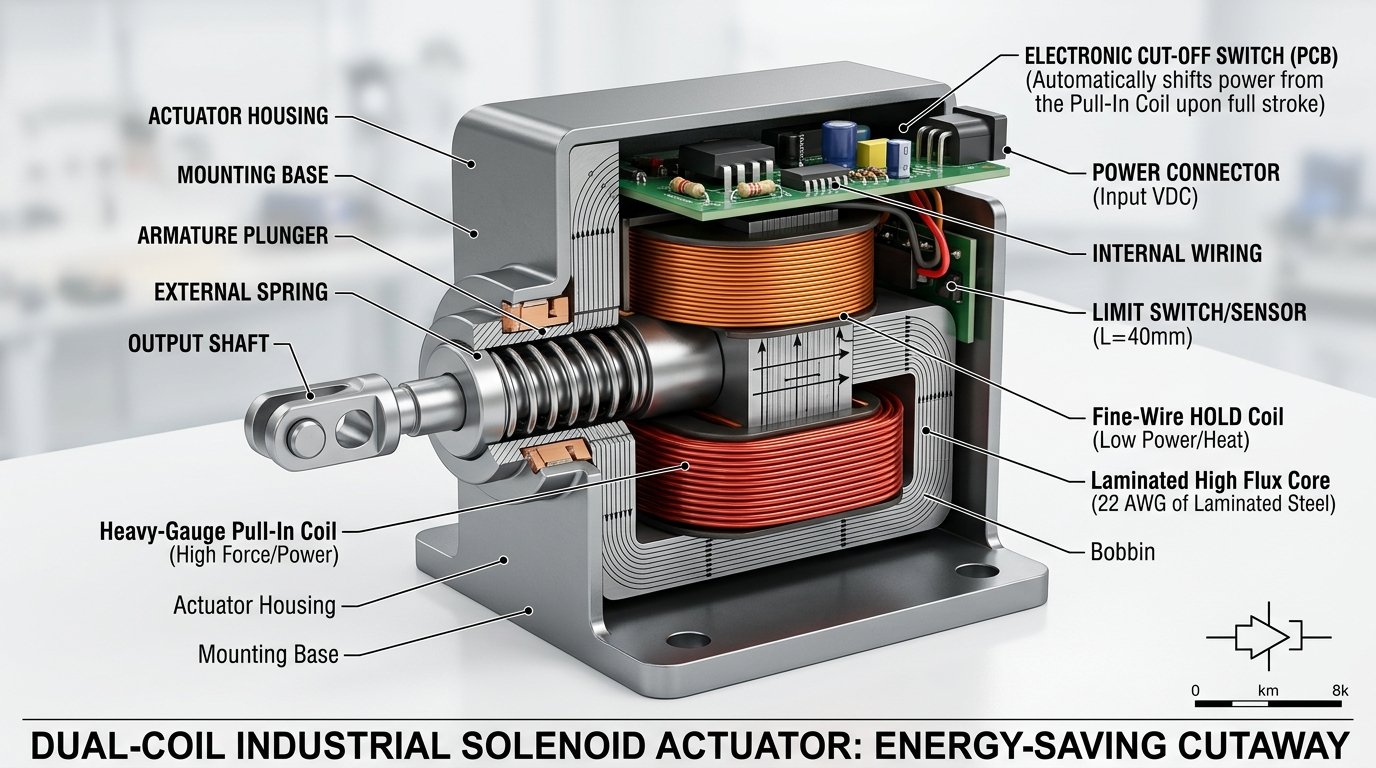
Dual-Coil Internal Structure Revealed: Seamless Cooperation Between the Heavy-Gauge “Pull Winding” and Fine-Gauge “Hold Winding”
To resolve this severe energy waste, engineers wound two distinctly different coils onto the same solenoid bobbin:
┌─────────────────────────────────────┐
│ Dual-Coil Internal Synergistic Mechanism │
└─────────────────────────────────────┘
│
┌─────────────────────────┴─────────────────────────┐
▼ ▼
【Pull Coil】 【Hold Coil】
- Features: Heavy gauge, fewer turns, extremely low resistance – Features: Fine gauge, many turns, extremely high resistance
- Function: Delivers high current for the initial 50 ms – Function: Maintains weak current (only 10%–20% energy consumption)
- Task: Generates strong pull force to bridge the air gap instantly – Task: Holds plunger during continuous duty, keeping casing warm to the touch
Flawless Operational Sequence:
1. Power-on Moment (0 to 50 ms): Both the pull coil and hold coil are energized simultaneously. The heavy-gauge coil produces an instantaneous peak magnetic force of dozens of amperes, snapping the plunger forcefully into place.
2. Seated Position Moment (> 50 ms): An internal mechanism or electronic circuit automatically cuts off power to the “Pull Coil” within tens of milliseconds, leaving only the high-resistance “Hold Coil” energized.
3. Continuous Holding Phase: At this stage, the circuit current plummets dramatically, reducing power consumption by 80% to 90%. Heat generation virtually disappears, and the solenoid’s metal housing remains safely warm to the touch!
Switching Mechanisms: What Cuts Off the Heavy-Gauge “Pull Coil”?
Modern dual-coil solenoids achieve millisecond-level intelligent switching primarily through two mechanisms:
1. Built-in Mechanical Microswitch Type (Ideal for Standalone Systems Without External PLCs)
A precision microswitch is built into the rear of the solenoid. When the plunger pulls in to the final 0.5 mm of its stroke, the tail of the plunger physically trips open the microswitch, positively disconnecting the pull coil’s power supply circuit.
- Advantages: Purely mechanical architecture requiring no external electronic drive board; operates autonomously by simply connecting two DC power leads.
2. Built-in Smart PWM Electronic Control Type (Standard for Modern High-End Equipment)
A miniature driver circuit chip is encapsulated directly inside the coil housing. The chip outputs 100% full pulse voltage during the first 100 milliseconds of energization, then uses high-frequency Pulse Width Modulation (PWM) technology to automatically reduce the voltage to a 20% holding voltage.
- Advantages: Free from mechanical switch wear, microsecond-level switching precision, superior vibration resistance, and an operational lifespan exceeding tens of millions of cycles.
Single-Coil vs. Dual-Coil Energy-Saving and Heating Test Comparison Table
Taking an industrial-grade DC solenoid with an 8 mm rated stroke and a 40 N pull force as an example:
| Performance Metric Item | Traditional Single-Coil Solenoid | Dual-Coil Energy-Saving Solenoid | Improvement Benefit Analysis |
|---|---|---|---|
| Starting Instantaneous Input Power | 60 W | 60 W (High thrust ensures reliable pull-in) | Both provide equivalent powerful pull-in force |
| Continuous Holding Input Power | Continuously maintained at 60 W! | Drops sharply to 6 W – 8 W | Power consumption plummets by over 85% |
| Surface Temperature After 4 Hours Continuous Duty | As high as 85°C – 100°C (Scalding hot with burning smell) | Only approx. 40°C – 48°C (Warm and comfortable) | Completely eliminates overheating risks to surrounding machinery |
| Coil Insulation Aging Rate | High temperature accelerates insulation degradation, leading to short lifespan | Consistently remains in safe low-temperature range, extending lifespan threefold | Significantly reduces downtime and maintenance costs |
| Allowable Duty Cycle (ED%) | Typically restricted to 25%–50% ED | Capable of 100% ED continuous duty | Meets 24/7 round-the-clock operation demands |
| Power Supply Unit Load | Requires high-power, expensive power supply units | Requires only miniature power supplies or low-capacity battery power | Reduces overall hardware procurement costs for the control cabinet |
Which Application Scenarios Strongly Recommend Upgrading to Dual-Coil Solenoids?
If your equipment exhibits any of the following characteristics, upgrading to dual coils will deliver an exceptional return on investment:
- Scenario 1: Medical Diagnostic Instruments and Semiconductor Fluid Control Equipment
- Extremely confined internal spaces that are highly temperature-sensitive (temperature increases can spoil reagents or cause thermal expansion inaccuracies).
- Scenario 2: Access Control Electric Locks and Safety Locking Mechanisms Energized 24/7
- Continuously in a locked state year-round; low-temperature operation completely eliminates scalding safety concerns and fire hazards.
- Scenario 3: Green Energy, Solar Storage, and Battery-Powered IoT Devices
- Systems run on battery storage; an 85% energy savings directly multiplies battery runtime severalfold.
- Scenario 4: Heavy-Duty Industrial Valves and Long-Stroke Braking Mechanisms
- Industrial environments requiring high pull-in thrust above 50 N, yet operating under poor heat dissipation conditions in the control cabinet.
Shih Shin Technology specializes in the R&D of electromagnetic actuation mechanisms, adhering to Taiwan HQ design and Asian manufacturing, with precision dual-coil winding processes and low-power driver encapsulation technology. Before leaving the factory, every energy-saving product undergoes 100% individual inspection across four key electrical indicators, ensuring powerful activation every time while remaining cool and energy-efficient over prolonged holding.
If your project is experiencing design bottlenecks due to solenoid overheating or excessive power consumption, feel free to contact the Shih Shin Technology engineering team at any time. We will evaluate and deliver the perfect low-power upgrade solution for you.