Targeting engineers searching for “reciprocating motion” or “push-pull action”.

Push-Pull Solenoid vs. Tubular Solenoid: How Do Structural Differences Determine Your Selection Efficiency?

An in-depth analysis of the structural differences between push-pull and tubular solenoids, exploring how magnetic leakage affects the force curve. Research shows that tubular structures provide 25% higher force stability than open-frame types when the stroke exceeds 10mm, and offer better "residual magnetism" control and a mechanical lifespan of tens of millions of cycles.

Continue ReadingPush-Pull Solenoid vs. Tubular Solenoid: How Do Structural Differences Determine Your Selection Efficiency?

Solenoid Maintenance 101: How to Extend Your Equipment’s Service Life

Solenoid failure modes vary after 1, 3, and 5 years of operation. This article analyzes the impact of thermal degradation, residual magnetism accumulation, and mechanical wear on lifespan from a designer's perspective, and provides specific maintenance and selection recommendations to help engineers minimize equipment failure rates.

Continue ReadingSolenoid Maintenance 101: How to Extend Your Equipment’s Service Life

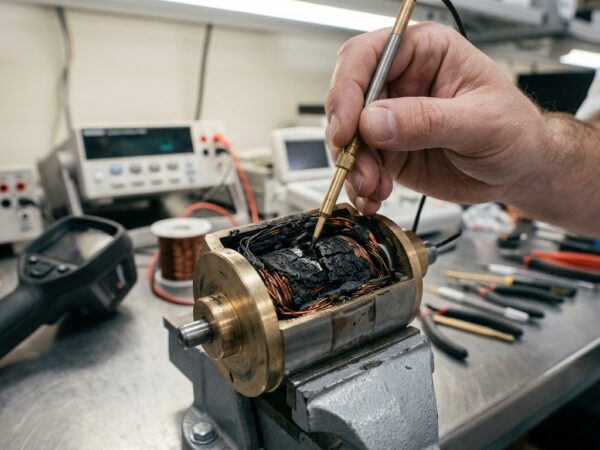
Preventing Coil Burnout: Analysis of Common Causes and Engineering Practices for Protective Circuit Design

Coil burnout often stems from thermal runaway and surge impact. This article analyzes the impact of ambient temperature rise on heat dissipation efficiency and points out that when the temperature rises by 10°C, the insulation life will be reduced by 50%. Through freewheeling diode design and PWM buck technology, the lifespan of solenoids can be effectively extended, and residual magnetism interference can be prevented.

Continue ReadingPreventing Coil Burnout: Analysis of Common Causes and Engineering Practices for Protective Circuit Design

Magnetic Circuit Saturation and Temperature Rise: Mechanical Calculations for Tubular Solenoids in Heavy-Duty Industrial Locking

Discussing the mechanical calculations of tubular solenoids in heavy-duty locking. When the operating temperature rises by 50 degrees, the pull force will be reduced by approximately 30% due to increased resistance. During design, precise verification of the pole face air gap and saturation point is required.

Continue ReadingMagnetic Circuit Saturation and Temperature Rise: Mechanical Calculations for Tubular Solenoids in Heavy-Duty Industrial Locking

Linear Solenoids vs. Motor Actuators: Physical Limitations and Engineering Decisions in Automated Equipment Selection

An in-depth analysis of key selection criteria for linear solenoids and motor actuators in automated equipment. From response speed, thermal balance, and maintenance costs to physical limitations, this guide offers a comprehensive comparison from a professional engineer's perspective.

Continue ReadingLinear Solenoids vs. Motor Actuators: Physical Limitations and Engineering Decisions in Automated Equipment Selection

Automotive Component Procurement Guide: 4 Key Specifications to Consider When Choosing Linear Solenoids and Solenoid Valves

This guide provides an analysis of 4 key specifications for automotive procurement of linear solenoids and solenoid valves, delving into the technical thresholds and selection strategies for automotive-grade parts, from force-stroke curves and duty cycles to residual magnetism.

Continue ReadingAutomotive Component Procurement Guide: 4 Key Specifications to Consider When Choosing Linear Solenoids and Solenoid Valves