Insulation class states the maximum temperature the coil’s insulation system can survive long-term, not the temperature the solenoid runs at. Class B is 130 °C, Class F is 155 °C and Class H is 180 °C. What you actually need to check is different: whether your ambient temperature plus the coil’s temperature rise stays under that limit, with margin.
What do the three letters B, F, and H represent?
| Class | Max hot-spot temperature | Typical allowed rise at 40 °C ambient |
|---|---|---|
| A | 105 °C | 60 K |
| E | 120 °C | 75 K |
| B | 130 °C | 80 K |
| F | 155 °C | 105 K |
| H | 180 °C | 125 K |
The classes come from IEC 60085 and describe the whole insulation system — enamel on the wire, layer and phase insulation, impregnating varnish, lead insulation — not just the magnet wire. Upgrading the wire alone does not upgrade the class, which is why a coil built from Class H wire on Class B bobbin material is still a Class B assembly.
Which number actually determines coil lifespan?
The Number That Actually Decides Survival
Insulation class is a ceiling. Coil temperature is where you sit under it, and it is set by three things you control: ambient temperature, power dissipated in the coil, and how long the coil stays energised versus how long it rests.
The arithmetic is: ambient + temperature rise + hot-spot allowance ≤ class limit. At 40 °C ambient a Class B coil has roughly 80 K of rise available; the same coil in a 60 °C cabinet has only about 60 K. Nothing about the coil changed — the available headroom halved because the environment did. This is why “which class do I need” cannot be answered without the ambient temperature.
Why Duty Cycle Changes the Answer
A coil energised for 2 seconds every minute and a coil energised continuously dissipate very different average power even at identical voltage. Continuous duty forces the coil to reach thermal equilibrium; intermittent duty lets it shed heat between operations, and the rise settles far below the continuous figure.
State duty cycle as actual on-time and rest time in seconds, not as a percentage. “10% duty” does not distinguish 0.1 seconds on and 0.9 seconds off from 100 seconds on and 900 seconds off, and those two cases have completely different peak coil temperatures. The open frame solenoid guide shows how force-stroke behaviour and duty cycle interact within one family.
The Rule of Thumb That Ages a Coil Early
Insulation life falls roughly by half for every 8 to 10 K of sustained overtemperature. A coil running 20 K above its class limit does not fail immediately — it fails much earlier than expected, months or years later, and the failure presents as a burnout with no obvious cause.
This is the mechanism behind a common field pattern: a machine runs correctly through commissioning and acceptance, then coils start failing after a season change raises the cabinet ambient. Nothing was specified wrong at 25 °C; the margin was simply consumed at 45 °C. See the troubleshooting hub for how this presents alongside other failure modes.
How do you choose a class without over-specifying?
A higher class is not automatically better. It usually means a different varnish and bobbin material, sometimes a different wire, and it costs more without adding force, stroke or speed. The class only earns its cost when the thermal budget needs it.
Work it in this order: measure or state the worst-case ambient, state actual on-time and rest time, let the manufacturer compute the expected rise for the coil that meets your force requirement, then select the lowest class that leaves at least 15 to 20 K of margin. If the answer lands on Class H for a continuous-duty position, that is usually a signal to re-examine the duty cycle rather than to buy a higher class.
How Shih Shin Technology Verifies Temperature Rise
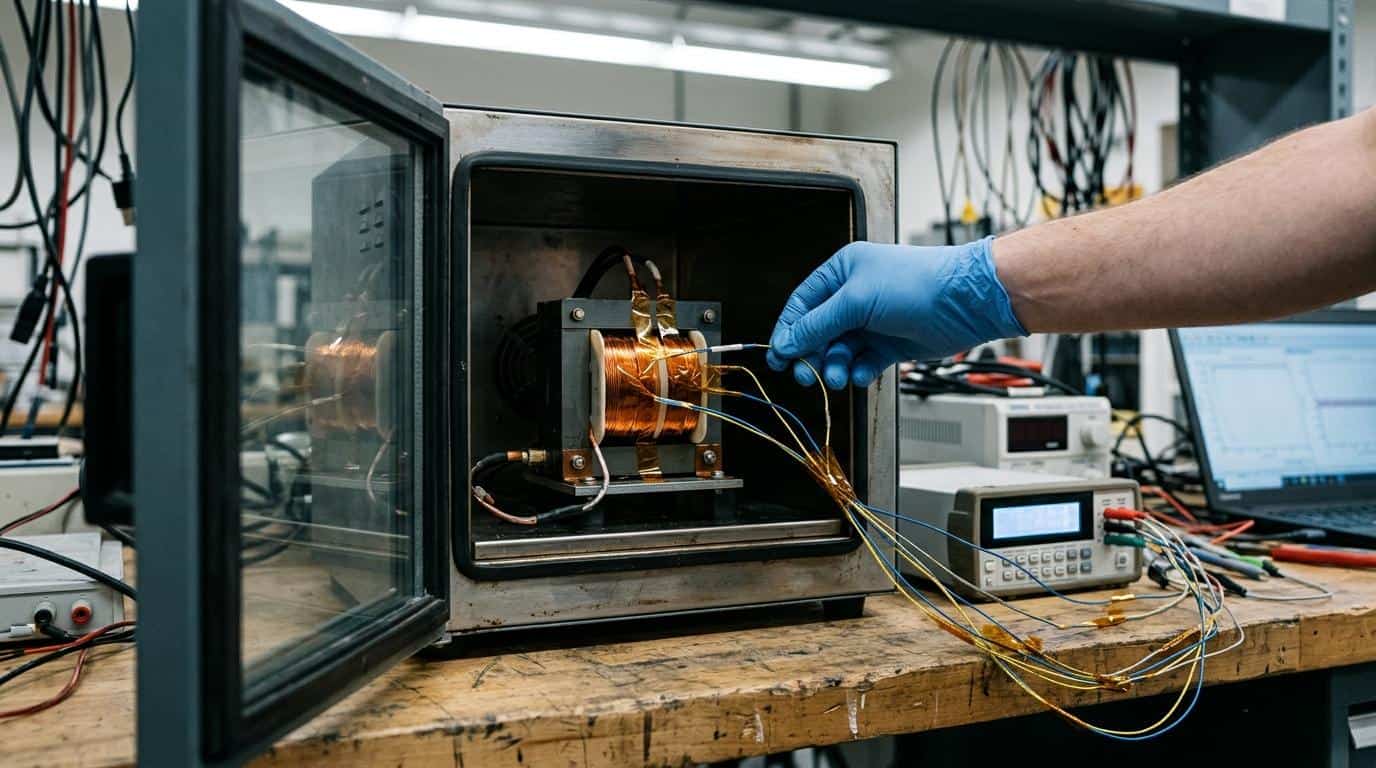
Inquiries about insulation classes often arise after seasonal changes: the same batch of solenoids works fine in winter, but the entire batch fails in summer when cabinet temperatures rise. The answer in these cases lies not in the class letter itself, but in whether the ambient temperature plus temperature rise exceeds that class’s limit. Our temperature rise is tested individually piece by piece rather than sampled, allowing us to match actual data against your cabinet conditions.
Class Is Not Chosen; It Is Calculated
B, F, and H are not protection ratings; they are thermal limits. What determines which class you need is not the coil itself, but whether the ambient temperature plus the temperature rise will exceed that limit—so looking solely at the coil will never give you the answer.
Usually, three parameters are enough: the worst-case ambient temperature at the installation location, the actual energizing and rest times in seconds, and the required holding or pulling force at the working stroke. Once the thermal budget is calculated, the insulation class is a deduced result, not an option.
Simply send these three details to info@solenoids.com.tw or submit them through the RFQ form. We will reply within 24 to 48 business hours detailing the expected temperature rise and its corresponding class. If you are still narrowing down the series, review the Solenoid Selection Guide Overview first.
Frequently Asked Questions
Does a Class H solenoid run cooler than a Class B one?
No. Class describes how much heat the insulation can tolerate, not how much heat the coil produces. Two solenoids of the same size and power dissipation run at the same temperature; the Class H unit simply survives that temperature where the Class B unit would degrade. If you need the coil to run cooler, change the duty cycle, the coil design or the heat path — not the class.
Can I use a Class F solenoid where Class H is specified?
Only if the thermal budget allows it, which means knowing the ambient and the actual duty cycle. A specification calling for Class H sometimes reflects a genuine 155 °C-plus hot-spot requirement and sometimes reflects a margin policy. Substituting downward without recomputing the budget removes margin you may not be able to see.
What ambient temperature should I quote — the room or the cabinet?
The air immediately around the solenoid, at the worst point in the duty cycle. A cabinet can sit 15 to 25 K above room temperature, and a solenoid mounted near a drive or a heater is hotter still. Quoting room temperature is the single most common way a thermal budget silently loses its margin.
How is temperature rise measured?
By resistance change rather than by a surface probe. Copper resistance rises predictably with temperature, so comparing coil resistance cold and at thermal equilibrium gives the average winding temperature — including the interior a surface sensor cannot reach. A surface reading typically understates the hot-spot.
Does insulation class affect withstand voltage?
They are related but separate. Class describes thermal endurance; withstand voltage describes dielectric strength at a point in time. A coil can be correctly classed and still fail a withstand test if the winding is damaged, and it can pass withstand while being thermally over-stressed. Both are checked on every unit produced.