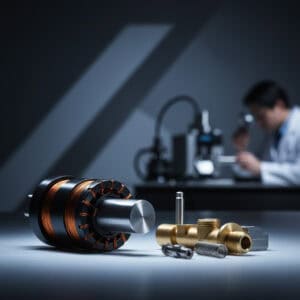
Failure Analysis of X-ray Bed Electromagnet Locking Mechanism
In a radiology examination room, an X-ray bed weighing hundreds of kilograms experienced a slight slip the moment a patient lay down, which can be fatal in precision imaging.
Why did the solenoid electromagnet, originally designed to lock the bed, lose its intended holding force at a critical moment?
Compared to the loose positioning of general industrial conveyor belts, medical-grade X-ray bed electromagnets require positioning accuracy within 0.05 mm. This is like braking on icy ground; if there’s a layer of melted ice between the brake pad and the wheel, the vehicle cannot stop instantly at the expected position, and residual magnetism acts like that layer of melted ice preventing release.
In medical imaging equipment, electromagnets not only provide locking force but also serve as the physical cornerstone for maintaining the precision of image reconstruction algorithms.
At an input voltage of 24 V, if the coil’s temperature rise due to continuous operation exceeds 85°C, its copper wire resistance will increase by approximately 25%, leading to a significant attenuation of electromagnetic force. This is particularly noticeable during continuous imaging schedules lasting several hours.
Causes of Residual Magnetism Issues in Medical Positioning Electromagnets
We must acknowledge that while pursuing ultimate locking force, the residual magnetism (Residual magnetism) generated by electromagnets after power-off often becomes another tricky hidden danger.
After disassembling the failed prototype that experienced slippage, we found that the contact surfaces of the moving and stationary cores had undergone slight deformation due to long-term impact, which exacerbated the delay in power-off release.
Impact of Anti-residual Spacer Wear in Electromagnetic Locking Systems
This physical deformation altered the original designed air gap (Air gap), extending the release time from the original 50 ms to over 300 ms.
- Incomplete annealing process of the moving and stationary core materials, leading to residual internal lattice defects.
- The anti-residual spacer (Anti-residual spacer) wears thin due to high-frequency impacts.
- The drive circuit lacks a design for rapid demagnetization or reverse pulse mechanisms.
Material Selection for Enhancing Medical Bed Electromagnet Stability
How can we simultaneously address the mutually exclusive physical demands of high holding force and low residual magnetism within a limited installation space? While increasing the number of coil turns can enhance locking force, it directly accelerates temperature rise, necessitating a compromise between volume and heat dissipation. This is a common holding force vs. Temperature rise tradeoff.
Although traditional low-carbon steel is inexpensive and easy to process, its hysteresis loop performance in high-frequency medical imaging equipment is far inferior to specially heat-treated soft magnetic iron.
In examination rooms where ambient temperature changes can reach 30°C, using soft magnetic iron with high saturation magnetic induction and low coercivity is the only feasible solution to ensure X-ray bed positioning error is less than 0.1 mm.
A saturation magnetic flux density of 1.2 T is the basic threshold for screening core materials, which ensures that the electromagnet maintains sufficient magnetic circuit efficiency even with a 15% volume reduction.
Shih Shin Technology Medical Electromagnet Solutions and Selection Guide
Although using imported high-purity soft magnetic iron increases initial material costs by approximately 18%, it leads to several years of maintenance-free operation for the equipment.
When evaluating medical bed positioning systems, engineers should prioritize examining three key indicators: dynamic response time, temperature rise curve, and slippage under extreme load.
For applications requiring a high safety factor, Shih Shin Technology (世僖科技) provides customized electromagnets with rigorous annealing treatment and precise air gap control, ensuring extremely low residual magnetism and stable locking force even after 100,000 operations.
Rather than blindly pursuing low-cost components, choosing electromagnets that strike a balance between physical limits and material science is the fundamental way to avoid subsequent maintenance disasters.
It is recommended to introduce simulation software for magnetic circuit analysis in the initial design phase and plan for a safety factor of at least 1.5 times to account for extreme load conditions.