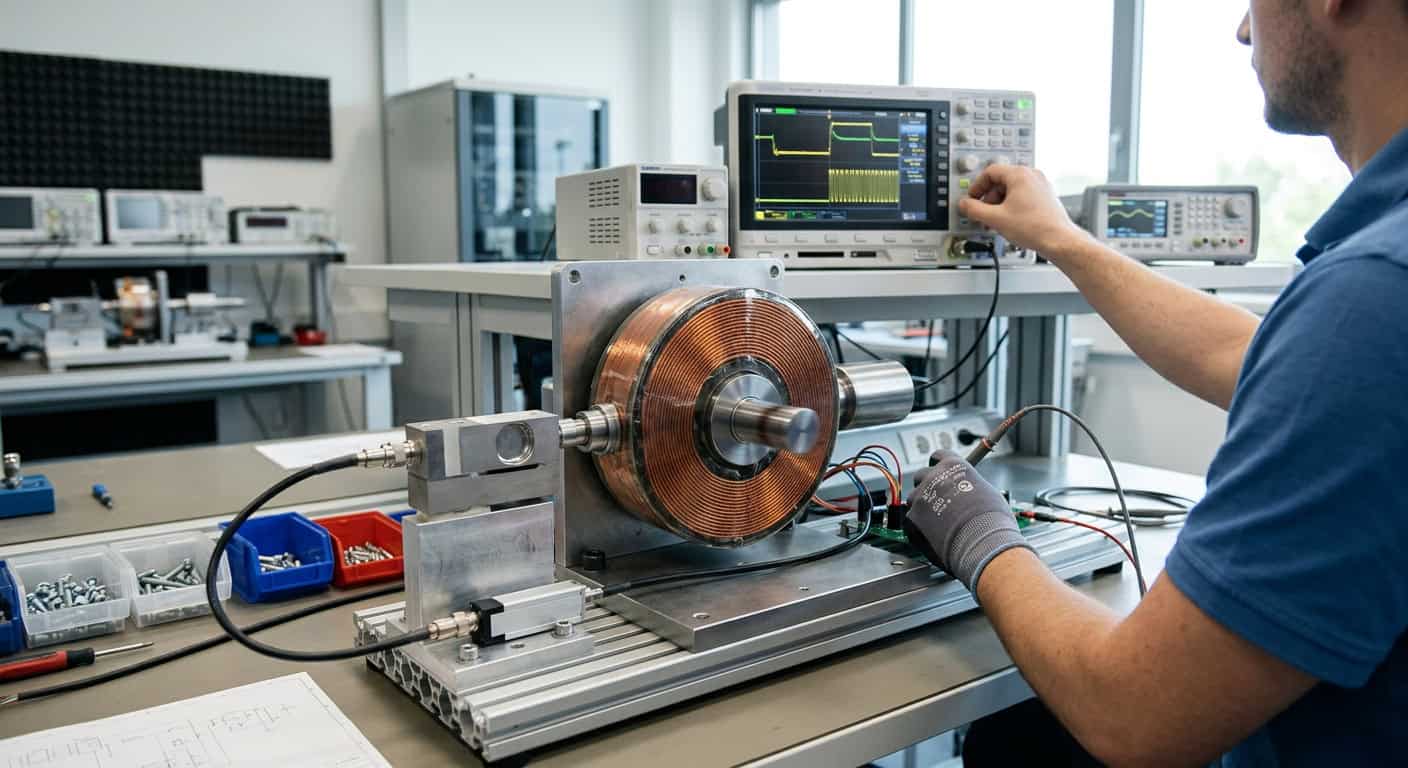
1 million fault-free operations is the basic threshold for ATMs and automatic ticket machines, but the seemingly simple round solenoids on the procurement list often jam due to dynamic pull force decay before reaching this number.
Why does round solenoid pull force calculation often become inaccurate after millions of operations?
We must admit that during initial selection, most buyers and engineers tend to directly apply the nominal value of static pull force, overlooking the dynamic changes during actual mechanism operation.
In the gate control of automatic ticket machines, solenoids need to complete engagement within 15 milliseconds (ms). At this time, the inductance effect of the coil hinders current rise, leading to actual pull force being much lower than the theoretical calculated value.
Mathematical Relationship Between ATM Solenoid Dynamic Response and Air Gap
The dynamic pull force formula must consider the nonlinear relationship between inductance and air gap. The formula is written as F = (N*I)^2 * u0 * A / (2 * g^2), where g represents the air gap. When the air gap approaches zero, the pull force increases exponentially, but this also means that any tiny mechanical wear will drastically change the pull force performance.
Engineering Insight: In high-speed dynamic response equipment, static pull force metrics are meaningless. What determines equipment lifespan is the remanence release speed at the minimum air gap state.
Measured Power Consumption and Temperature Rise Formulas for Automatic Ticket Machine Solenoids
Why do round solenoids, perfect when tested in the lab, burn out due to overheating within three months of operation when installed in the narrow casing of a vending machine?
The resistance value indicated in general specifications is measured at 20 degrees Celsius. However, when the equipment is continuously powered on and the internal temperature rises to 80 degrees Celsius, the copper wire resistance increases by approximately 24%, leading to a synchronous decrease in current and pull force.
Holding Force Decay of Vending Machine Solenoids Under Continuous Power
Solenoids with 100% duty cycle typically experience a holding force decrease of more than 30% after temperature rise stabilization. At this point, we must introduce the temperature rise correction formula: R_hot = R_cold * [1 + 0.00393 * (T_hot – T_cold)] to re-evaluate the safety factor at extreme temperatures.
| Operating Temperature (°C) | Coil Resistance Increase Rate (%) | Actual Pull Force Retention Rate (%) |
|---|---|---|
| 20 | 0% | 100% |
| 50 | 11.8% | 89% |
| 80 | 23.6% | 76% |
From Formula to Reality: Dynamic Design to Avoid Remanence Interference
Undeniably, in pursuit of ultimate response speed, engineers often fall into the trap of blindly increasing drive current when designing high-frequency actuation mechanisms, overlooking the resulting problem of remanence retention. When the current is cut off, the residual magnetic flux inside the iron core cannot immediately return to zero, preventing the armature from releasing promptly and thus affecting the next operating cycle of the entire automation mechanism.
When an ATM sorts banknotes or recognizes coins, if a solenoid delays its release by just 0.01 seconds due to remanence, it could lead to banknote jams in the transport track or coin sorting errors. The accumulation of such tiny delays is like extended braking reaction time on a highway; seemingly operating normally, but under high-volume load, a slight deviation can cause the entire machine to shut down without warning.
When a round solenoid operates at a frequency exceeding 5 times per second, a non-magnetic gap of at least 0.05mm must be incorporated into the magnetic circuit design; otherwise, remanence accumulation will cause release delays exceeding 20 milliseconds.
So, without sacrificing initial pull force, how can engineers precisely control the decay speed of remanence to meet the stringent requirements of high-frequency equipment?
The traditional approach is simply to increase the spring force of the return spring, but this directly offsets the solenoid’s initial pull force at a distance, leading to difficult activation. A better solution is to start with materials science, optimizing the material formulation of the iron core and armature, selecting electromagnetic soft iron with high saturation magnetic induction and extremely low coercivity, and applying a special anti-remanence electroplating treatment to the contact surfaces, thereby fundamentally eliminating release delays caused by hysteresis.
How to Choose the Most Durable Round Solenoid Solution for High-Frequency Equipment
Three key indicators determine the success or failure of selecting high-frequency equipment: first, the pull force margin at extreme temperature rise; second, the remanence release time; and third, the wear life of sliding components.
Shih Shin Technology (世僖科技)’s approach in similar cases is to provide customized magnetic circuit simulation and dynamic pull force testing for the specific needs of high-frequency ATMs and automatic ticket machines, ensuring that the solenoids maintain stable release time and pull force performance even after ten million operations.
Selecting round solenoids is not just about understanding static data in specifications; it also requires incorporating dynamic temperature rise and remanence effects into the initial mathematical model. Only by precisely grasping these physical limitations during the design phase can the accuracy and reliability of the end equipment be ensured during years of high-intensity operation.
It is recommended to provide equipment operating frequency and ambient temperature data during the initial design phase for dynamic magnetic circuit simulation, which can reduce subsequent modification and testing time by more than 50%.