Must Custom Solenoids Always Require Tooling from Scratch? Cost and Lead Time Advantages of Semi-Customization from 44 Standard Models
Must Custom Solenoids Always Require Tooling from Scratch? Cost and Lead Time Advantages of Semi-Customization from 44 Standard Models
In the early R&D stages of new projects for smart hardware, automation equipment, or medical devices, hardware architects and project procurement managers (PMs) often face a difficult decision crossroads: “Existing off-the-shelf standard solenoids are always just slightly off in dimensions or thrust, but if we develop full custom tooling from scratch, the exorbitant tooling costs and lead times of 8 to 12 weeks are simply unacceptable for the project budget and time-to-market.”
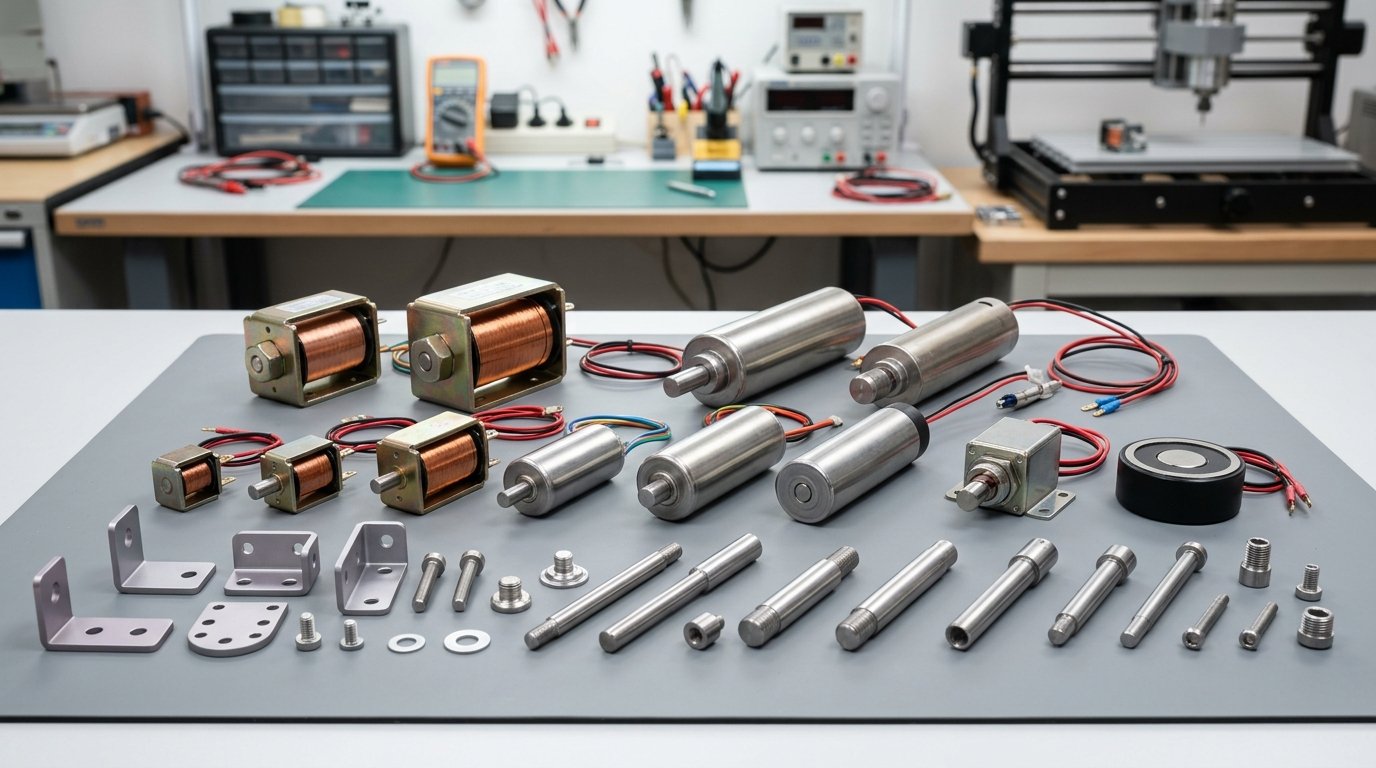
Many teams mistakenly believe that “customization” means “creating brand-new tooling from scratch.” In fact, within mature industrial actuator supply chain systems, “semi-custom engineering” based on mature standard frame platforms is the mainstream industry practice. In this article, the Shih Shin Technology engineering team decodes how to leverage Shih Shin Technology’s existing 44 standard open-frame, tubular, and latching actuator core architectures to precisely build dedicated custom power cores under the condition of “Zero Tooling Cost.”
1. Full Custom Tooling vs. Standard Architecture Semi-Custom: A Comprehensive TCO and Time Cost Comparison
During initial project initiation, procurement managers reviewing budgets should objectively evaluate the differences in resource investment between the two development models:
Full Custom Tooling vs. Standard Architecture Semi-Custom Evaluation Matrix
Evaluation Dimension
Full Custom Tooling (Full Custom)
Standard Architecture Semi-Custom (Semi-Custom)
Project Comprehensive Benefit Analysis
Initial Tooling Costs (NRE)
NT150,000 to over NT500,000 (stamping molds, injection molds, die-casting molds)
NT0 (No tooling fees)
Completely eliminates upfront sunk capital risk
Initial Prototyping Lead Time
8 to 14 weeks (tooling fabrication, trial molding, mold modification)
2 to 3 weeks (rapid assembly with existing tooling)
Secures critical product validation time and market first-mover advanta≥
Minimum Order Quantity (MOQ)
Typically requires 5,000 to 10,000+ units
Flexib≤ (supports small batches of 200–500 units)
Significantly reduces inventory capital pressure during startup and pilot production stages
Technical Maturity and Yield Rate
Requires a lengthy process validation and ramp-up period
Adopts mature magnetic circuits and tooling validated across millions of units
High quality stability, eliminating the risk of out-of-control tooling tolerances
2. Which Core Parameters Can Be Semi-Customized on Top of the 44 Standard Base Models?
Shih Shin Technology has been deeply rooted in the electromagnetic actuation field for decades, developing 44 mainstream specification sizes across three major categories: Open Frame, Tubular, and Latching. On this mature foundation, engineers can freely adjust the following parameters:
Six Engineering Dimensions for Flexib≤ Customization Without Tooling
Precise Coil Volta≥ and Impedance Matching:
Within the same housing and bobbin volume, engineers can freely specify operating voltages (DC 3V to 220V, AC 110V/220V). By adjusting wire diameter (AWG 28 to AWG 44) and winding turns, ampere-turns (N cdot I) can be precisely tuned to perfectly accommodate lithium battery power or dedicated power supply modules.
Plunger Geometry Customization:
The plunger is precision-machined via CNC lathes without any tooling required! Shaft diameter, length, external threads (M3/M4/M5), internal threads, pin holes, E-ring grooves, or special flat cuts can be freely specified based on mechanical requirements.
Po≤ Face Attraction Curve Optimization (Flat Face vs. Conical Face):
The moving core and end cap can be freely specified with a flat face (short stroke, ultra-high force) or a 60°/90° conical face (long stroke, gradual force) to alter the dynamic push-pull output curve.
Thermal Insulation Class Upgrade:
Coil enameled wire and wrapping tape can be upgraded directly from standard Class B (130°C) to high-grade Class F (155°C) or Class H (180°C), enhancing thermal margin during high-frequency operation.
Lead Wire Length and Automotive/Industrial Terminal Crimping:
Customize lead wire length and temperature ratings (Teflon wire, silicone wire, metal braided shielded wire), with direct crimping of JST, Molex, TE connectors, or automotive-grade waterproof connectors for modular plug-and-play.
Diversified Mounting Brackets and Ho≤ Configurations:
Existing metal frames can undergo CNC drilling or laser-assisted processing to adjust mounting ho≤ sizes and orientations, perfectly fitting existing chassis spaces.
3. How Project Leaders Evaluate: When to Semi-Customize vs. When Full Custom Tooling Is Essential?
To assist PMs in making informed decisions, here is a clear engineering decision pathway:
Customization Pathway Decision Checklist
Is There Tolerance for Minor Adjustments in Installation Space (pm 1–2mm)?
If mechanical sheet metal is still in the 3D design or 3D printing prototyping stage, it is strongly recommended to “fine-tune the enclosure based on standard model outer dimensions” and semi-customize internal coils and plungers from mature models, saving hundreds of thousands in tooling costs and months of waiting time.
Does Annual Demand Reach Hundreds of Thousands of Units?
If the project’s annual demand is under 50,000 units, the comprehensive per-unit cost and risk of semi-customization are far superior to full custom tooling; if annual demand reaches the millions and space constraints hit millimeter-level limits, initiating dedicated custom tooling development offers better unit price economies of scale.
Does the Project Require Extremely Fast Verification (Time-to-Market)?
If clients require a working prototype within 1 month for exhibitions or fundraising milestones, semi-customization is the only feasible route to deliver high-precision custom actuators in 2–3 weeks.
Eliminate Tooling Burdens and Protracted Waits: Driving Agile Innovation with Modular Platforms
New project development phases often face the dual challenges of tight budgets and rapid time-to-market. Based on 44 mature, validated standard open-frame, tubular, and latching platforms, Shih Shin Technology’s Taiwan R&D team provides clients with complimentary coil winding impedance tuning, CNC plunger thread turning, and flexible mounting face adjustments; the Asian manufacturing center supports flexible small-batch prototyping and rapid ramp-up, helping hardware teams bring engineering concepts to market with zero tooling costs (Zero NRE) and ultra-short lead times of just a few weeks.