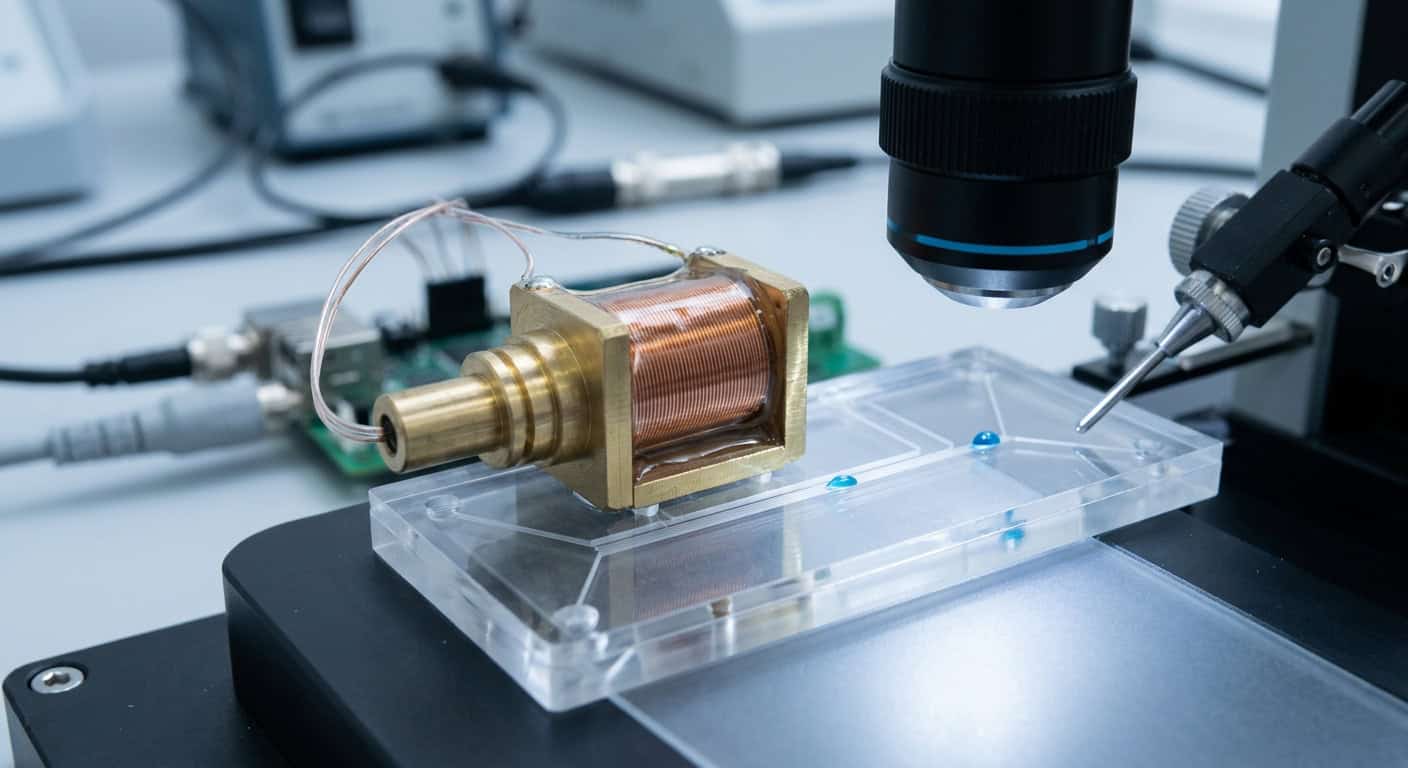
Specification data on a tender list may look perfect, but in the high-precision testing of a microfluidics lab, those overlooked physical variables are often the primary reason millions in R&D funding go down the drain. Unlike large industrial machinery, microfluidic equipment requires extreme repeatability and minimal thermal interference rather than powerful thrust.
The “Microfluidic Precision” Trap Most Easily Overlooked When Purchasing Micro Solenoids
Compared to traditional automation equipment, biotech and medical devices define the performance of micro solenoids entirely differently. A difficult-to-bridge technical gap exists between millisecond-level response times and microwatt-level power consumption. Many procurement teams initially focus only on rated voltage and stroke, only to discover during the prototyping phase that the shear force or backpressure generated by the fluid at the valve port far exceeds the load capacity of cheap electromagnets.
The difference between 5 ms and 15 ms in opening and closing times might be negligible in a general logistics sorting system. However, in the droplet generation process for DNA sequencing or drug development, this 10-millisecond delay can cause an 8% to 12% deviation in fluid volume. This accumulation of errors at the microscopic scale is the core reason many biotech devices fail clinical validation. Looked at another way, choosing components isn’t just about functionality; it’s about purchasing the expected stability of the system.
In microfluidic systems, if the response time deviation of an electromagnet exceeds 2 milliseconds, the volume error for a picoliter-scale droplet generation system will soar directly to over 15%.
Choosing the Wrong Specs to Save Money? Three Hidden Costs of Micro Electromagnets in Biotech Equipment
Let’s face it: choosing standardized specifications early in a project to lower Bill of Materials (BOM) costs usually results in maintenance costs several times higher later on. Standard electromagnets are not designed with the sensitivity of biochemical reactions to temperature rise in mind. When a micro electromagnet operates continuously for 30 minutes inside a sealed diagnostic instrument, the heat generated by the coil is conducted to the fluid sample, potentially causing protein denaturation or reagent failure.
| Evaluation Metric | Standard Industrial Solenoid | Medical-Grade Microfluidic-Specific Type |
|---|---|---|
| Continuous Operation Temperature Rise (ΔT) | +35°C @ 100% ED | < +12°C @ 100% ED |
| Residual Magnetism Impact | High, requires additional spring compensation | Extremely low, utilizes special magnetic materials |
| Opening/Closing Response Time | 20-40 ms | < 8 ms |
- Thermal Stability: Internal space in biotech equipment is cramped with poor heat dissipation; low-power design is the only solution.
- Material Compatibility: The valve body structure must resist corrosion from biochemical reagents, which involves the chemical inertness of sealing materials.
- Residual Magnetism Control: If the magnetic circuit design is imprecise, residual magnetism will cause armature sticking, resulting in microfluidic switching delays.
Residual Magnetism and Temperature Rise: The Physical Limits Determining the Lifespan of Micro Solenoid Control Valves
Simply put, the physical rules of the microscopic world are defined by material science. During the frequent opening and closing of micro solenoid control valves, the accumulation of “residual magnetism” within the magnetic circuit is the primary cause of inconsistent performance. If the magnetic circuit is likened to a spring with memory, when it fails to return to its original state quickly after power is cut, the logic of the entire control system collapses. To overcome residual magnetism, some designs increase the strength of the return spring, but this in turn leads to higher power consumption, creating a vicious cycle.
Engineers must make complex trade-offs between coil turns, magnetic alloy purity, and driving voltage during design. For instance, using high-purity soft magnetic alloys can effectively reduce residual magnetism, but costs will increase by 20% to 35%. However, compared to the zero-failure performance of the equipment in hospitals or laboratories, the return on investment for this cost is extremely high. If these physical boundaries are ignored, the equipment often exhibits sluggish movement or jamming after three months of operation.
Magnetic Circuit Optimization and Material Selection for Microfluidic Solenoid Valves
The real key lies in balancing the contradiction between electromagnetic force and volume. In the development of microfluidic solenoid valves, we often find that simply increasing the current does not solve the problem of insufficient thrust; instead, it leads to a significant drop in efficiency due to magnetic saturation. High-quality micro-components use precisely calculated magnetic pole gaps to ensure stable linear force output within extremely small spaces while minimizing residual magnetism interference.
How to Establish a Selection Checklist for Microfluidic Solenoid Valves?
Faced with a dazzling array of specification lists on the market, procurement and engineering teams need a standardized decision-making framework. First, the duty cycle of the equipment should be confirmed, as this directly determines the calculation basis for thermal balance; second is the fluid pressure range, which relates to the load the solenoid must overcome. Shih-Shin Technology (世僖科技)’s approach in similar cases is to simulate the customer’s specific fluid path, ensuring that the electromagnetic components maintain the expected response curve under actual fluid resistance.
Finally, do not forget to consider environmental factors, including humidity requirements for coil insulation class. Equipment in the biotech industry often needs to operate for years in strictly controlled environments; any subtle material aging will be reflected in the drift of detection data. Rather than searching for replacement parts after a failure occurs, it is better to conduct rigorous testing on the two core indicators—residual magnetism and temperature rise—during the initial design phase. Choosing a partner with customization capabilities allows R&D teams to focus their energy on breakthroughs in biochemical technology rather than being troubled by the physical defects of basic components.
When performing initial selection, please request response time drift data from the supplier after 10,000 continuous operations. If the drift exceeds 5% of the original set value, the anti-residual magnetism performance of the magnetic circuit material must be re-evaluated.