
The Industrial Philosophy Dilemma: Why “Specification Sheets” Cannot Fully Define Component Quality
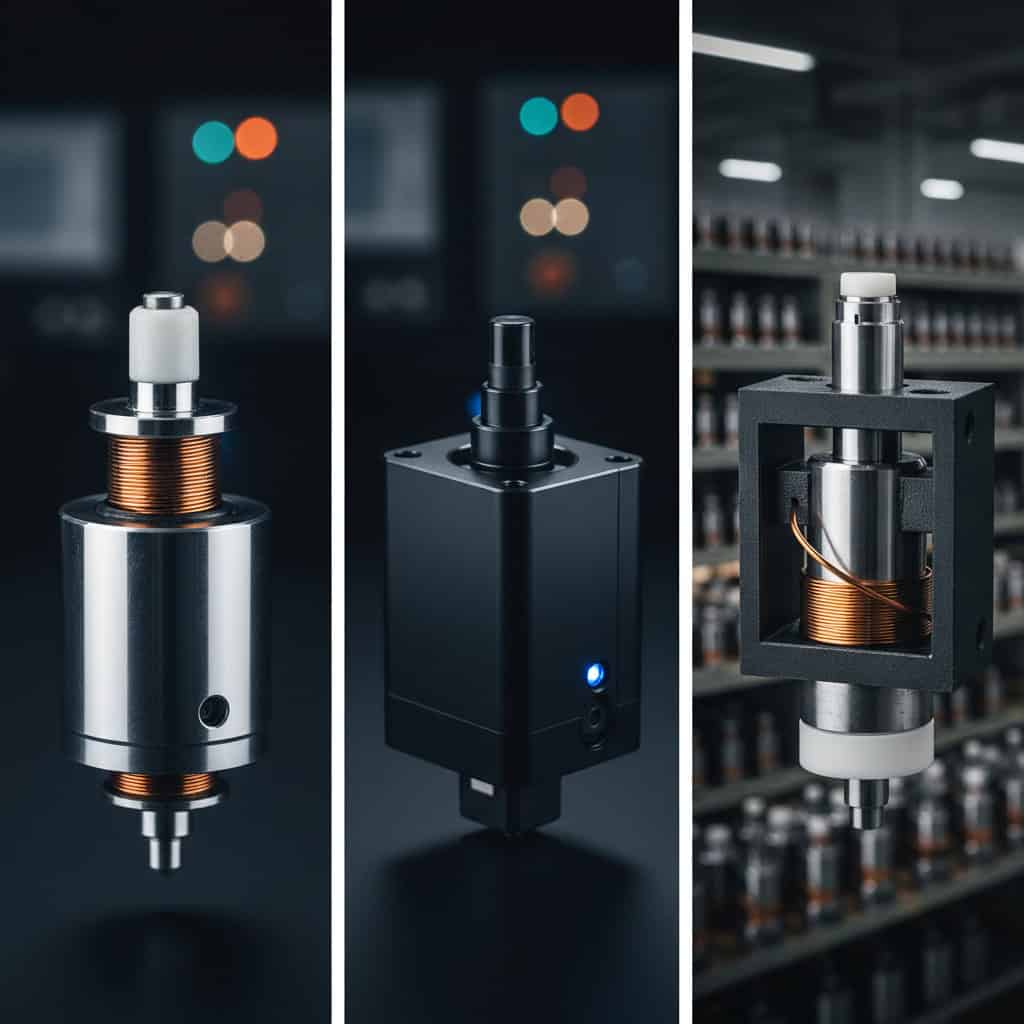
In the world of precision electromagnetic components, a common engineering paradox is: two products with identical Solenoid Force Curves and external specifications often exhibit vastly different performance after hundreds of thousands of continuous operations. The core logic hidden behind this is not merely a cost difference, but rather the fundamental understanding of material science and process tolerances by different manufacturing systems. From observations on the production floor, the stability of a solenoid often depends on unseen details, such as how the purity of magnetic conductive materials affects Residual Magnetism, and how the tightness of coil winding determines heat dissipation efficiency.
Engineering Axiom: In extreme applications, the failure point of a component is often not at the upper limit of the specification sheet, but rather in the fatigue performance of the material under thermal equilibrium.
The Deep Interplay of Technical Indicators: Magnetic Conductive Materials, Insulation Classes, and Long-term Reliability
When we dissect the three major manufacturing hubs in Asia, the technical watershed is clearly visible. Taiwanese suppliers tend to specialize in high-to-mid-range customized needs, with extremely strict control over Insulation Classes. Especially when dealing with temperature rise issues caused by frequent operations in automated equipment, Taiwanese products exhibit excellent thermal stability. In contrast, Korean suppliers demonstrate strong modular integration capabilities, often pre-integrating solenoids with precision mechanical parts, suitable for electronic products with very high demands on appearance and packaging.
Regional Manufacturing Advantage Comparison Table
| Manufacturing Region | Core Technical Advantage | Typical Tolerance Control | Optimal Application Area |
|---|---|---|---|
| Taiwan | High magnetic conductive material applications, ultra-low residual magnetism control | ±0.02mm – 0.05mm | Precision industrial equipment, medical instruments, new energy vehicles |
| Korea | Modular packaging, precision mechanical integration | ±0.05mm – 0.10mm | Consumer electronics, high-end smart home, automotive interior |
| China | Mass production capacity advantage, standard component cost control | ±0.10mm – 0.20mm | General small appliances, low-frequency switching equipment |
Chinese manufacturing, on the other hand, possesses unparalleled cost competitiveness in scaled production and standardized components. However, when faced with industrial environments requiring long-term operation, large factories often have to make more trade-offs in the redundant design of the Duty Cycle to compensate for potential magnetic saturation phenomena of materials in extreme environments. This also explains why, in precision semiconductor equipment or critical medical devices, engineers often steer clear of purely cost-driven approaches, instead pursuing supply chain systems with higher precision.
How to Make Decisions Amidst Performance Paradoxes: Strategic Selection for Application Scenarios
This is a crossroads for technical selection. If your application involves medical and laboratory equipment, where stability and bio-safety are absolute priorities, precision solenoids manufactured in Taiwan become the first choice due to their stringent incoming material inspection and low-noise characteristics. If the scenario shifts to electric vehicles and smart transportation, where components must operate under high vibration and extreme temperature differences, then the coil’s potting process and structural strength become the key to success.
Much data feedback from production lines shows that failed solenoids are often due to overlooking the impact of environmental humidity on insulation performance, or micro-deformation of the support structure after millions of reciprocating movements. Rather than maximizing a single indicator, the key is often to find the “sweet spot” between the material’s coefficient of thermal expansion and dynamic friction coefficient.
Towards Ultimate Precision: Shih Shin Technology’s Strategic Role in Custom Electromagnetics
Amidst the severe fluctuations in global supply chains, Shih Shin Technology is not just a component supplier, but a strategic partner providing advanced solutions. We deeply understand that every stroke curve represents the operational efficiency of equipment, and every degree of temperature rise is crucial to the long-term lifespan of the system. Leveraging a profound understanding of magnetic materials and precision processing technology, Shih Shin Technology has established a strong technical barrier in the field of customized electromagnets, offering comprehensive technical support from R&D and simulation to mass production for high-end industries worldwide, ensuring that every component maintains excellent performance output even in harsh environments.


