
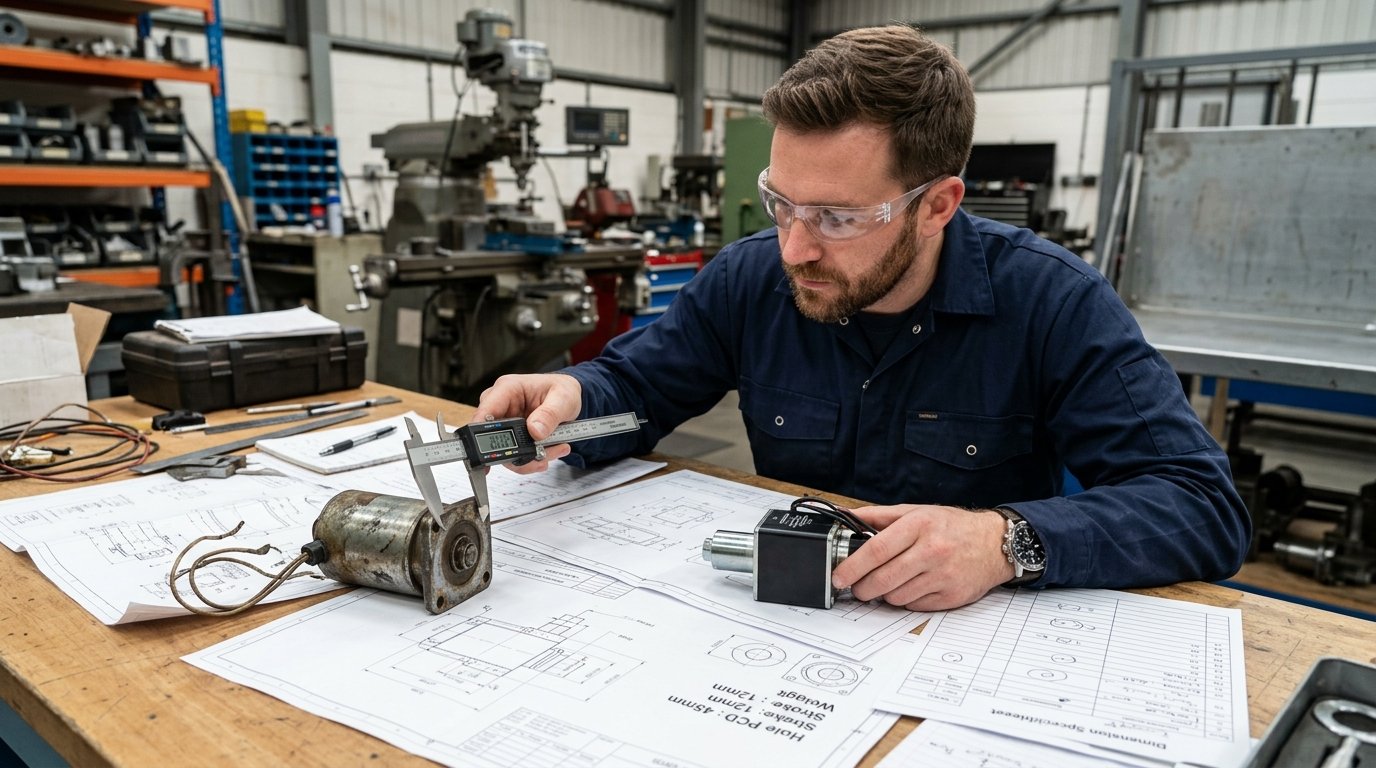
During the operation and maintenance of semiconductor packaging and testing equipment, precision surface-mount machines, large textile printing presses, and various imported automated production lines, one of the most common supply chain crises faced by equipment procurement managers and maintenance engineering teams is when existing OEM solenoid models (such as imported European, American, or Japanese brands) are declared End of Life (EOL) or face ultra-long lead times of six months or more.
OEM discontinuation of imported parts does not mean having to spend millions to replace entire machines. Through professional second-source cross-reference evaluations, it is entirely possible to achieve seamless, compatible drop-in replacements with cost-effective, short-lead-time domestic or Asian supply chain solutions—under the premise of “not modifying the machine’s existing sheet metal structure and not replacing electrical control boards.” Compiled by the Shih Shin Technology engineering team, this article outlines the Checklist for Aligning Four Core Parameters, providing equipment procurement managers and maintenance supervisors with a systematic alternative selection guide.
1. Mechanical and Mounting Interface Compatibility
The top priority when sourcing a replacement part is ensuring that the new actuator can be mounted directly into the machine’s existing reserved space, avoiding on-site milling or machine frame modifications:
Mechanical Mounting Dimension Review & Alignment Table
| Mechanical Alignment Parameter | Discontinued OEM Part Measurement Focus | Replacement Part Selection Tolerance Standard |
|---|---|---|
| Mounting Pitch | Base mounting hole center-to-center distance, thread specifications (M3/M4/UNC) | Must align 100% precisely (tolerance ≤ ± 0.1mm) |
| Overall Body Profile | Length, width, height, and lead wire exit direction | All dimensions of the replacement part must be equal to or smaller than the original space boundaries |
| Plunger Rod Diameter and Threading | Plunger outer diameter (OD), tip thread specifications (male/female thread) | Shaft diameter must be fully compatible with the original load connector or linkage |
| Plunger Travel Limit (Stroke) | Free extended length and total stroke when fully retracted | The rated stroke of the replacement part must be ≥ the OEM-specified operating stroke |
2. Stroke and Force Curve Alignment: Avoiding “Strong at Short Stroke, Unable to Actuate at Long Stroke”
Many procurement personnel only compare the single maximum holding force value on datasheets, which is often the primary cause of replacement failure. A solenoid’s electromagnetic force is a non-linear curve that varies with stroke:
1. Force Matching Across the Operating Stroke Range
It is essential to obtain the OEM model’s Stroke-Force Curve.
- Initial Force Review: Verify whether the pull/push force of the replacement part at the maximum air gap during load initiation (e.g., at 8 mm) exceeds the original load’s static friction and spring preload.
- Safety Margin Factor: Shih Shin Technology recommends that the electromagnetic force of the replacement part at each stroke point be maintained between 1.2 and 1.5 times the original design value, ensuring reliable actuation while avoiding excessive end-stroke impact.
2. Return Spring Force Balance
If the original solenoid features an internal return spring, measure the spring’s free length, outer diameter, and spring rate (Spring Constant, k). The replacement part must be configured with a spring of equivalent force to prevent the plunger from failing to return or encountering excessive extension resistance after replacement.
3. Electrical Parameter Alignment: Voltage, Resistance, Duty Cycle, and Drive Compatibility
Aligning electrical specifications is the critical lifeline for preventing coil burnout and protecting PLC output modules:
Electrical Parameter Quick Verification Checklist
- Operating Voltage and Power Supply Type: Accurately verify whether it is DC 12V, DC 24V, AC 110V, or AC 220V. Never substitute AC for DC, or use mismatched voltage ratings.
- Coil DC Cold Resistance (R_coil): The resistance of the replacement part should closely match the OEM model (deviation controlled within ± 10%). If the replacement resistance is too low, excessive current will be drawn, causing switching transistors or relay contacts on the control board to burn out; if the resistance is too high, insufficient ampere-turns will lead to degraded pull force.
- Rated Duty Cycle (Duty Cycle / ED%): The nominal ED% rating of the replacement part must be greater than or equal to the OEM specification. If the original equipment operates continuously (100% ED), never replace it with an intermittent 25% ED or 50% ED part.
- Insulation Temperature Class: The temperature rating of the replacement coil (Class B 130°C / Class F 155°C / Class H 180°C) must be equal to or higher than the original specification.
4. SOP for Procurement and Maintenance Replacement Part Evaluation
When dealing with discontinuation emergencies, procurement managers are advised to follow this four-step standard operating procedure to efficiently drive replacement cross-referencing and verification:
Four Key Phases of EOL Replacement Part Evaluation
- Measuring Active Legacy Parts & Parameter Profiling: Retrieve an intact OEM sample, use vernier calipers to measure mounting hole pitch and shaft dimensions, measure coil resistance with a multimeter, and record the model number, voltage, and duty cycle from the nameplate.
- OEM Datasheet Cross-Referencing: Provide the measured data and existing drawings to a specialized solenoid manufacturer (such as Shih Shin Technology). The engineering team quickly matches the closest frame structure from a database of 44 standard bobbins and frames.
- Sample Prototyping & Custom Fine-Tuning: By flexibly adjusting coil turns and machining plunger threads, 100% interface-compatible custom equivalent prototypes can be delivered within 1 to 2 weeks.
- On-Site Machine Verification & Low-Volume Transition: Install the prototype on a single production line machine for a 48-hour continuous run test. Once temperature rise, response time, and mechanical concentricity are fully verified, formally add it to the spare parts list and phase in the transition.
Overcoming OEM Discontinuation and Ultra-Long Lead Times: Agile Replacement Solutions for Equipment Procurement
Faced with OEM part number discontinuations (EOL) from European, American, or Japanese brands and ultra-long lead times stretching dozens of weeks, equipment maintenance teams should not be trapped into modifying machines or absorbing exorbitant downtime costs. The Shih Shin Technology Taiwan Technical Center has built a comprehensive specification database of international actuator brands along with reverse-engineering benchmarking capabilities. By strictly matching mounting pitches, stroke-force curves, and resistance-thermal characteristics, Shih Shin Technology leverages Asia’s flexible and agile manufacturing supply chain to provide highly compatible, high-quality, and dramatically shorter-lead-time Second Source replacement solutions.


