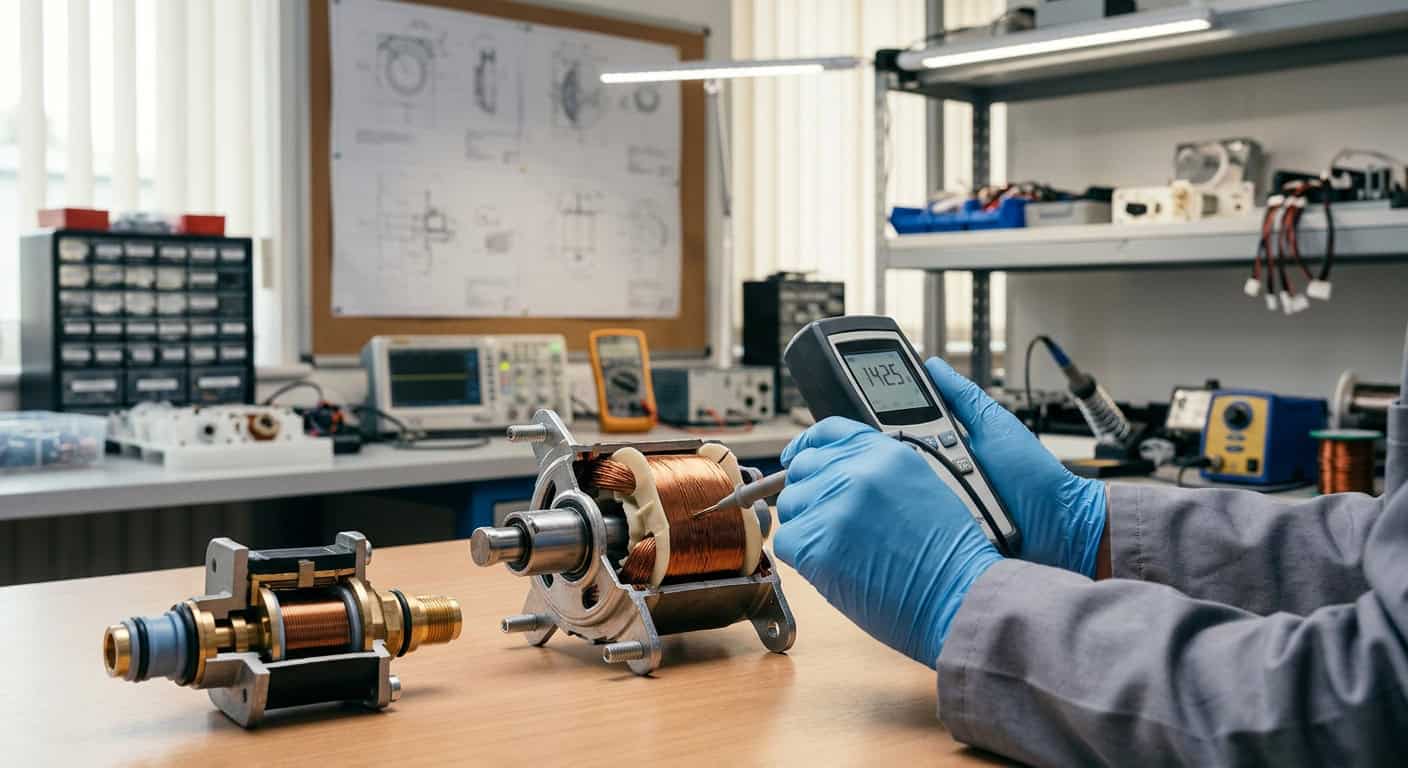
Disassembling a front-load washing machine that had stopped working due to a door lock malfunction, the control board showed normal signals, but the door lock safety electromagnet failed to reset because its internal coil was burned out due to moisture. What wasn’t visible on the schematics was how tiny condensation droplets, under the high humidity and high-temperature steam environment of daily washing, could infiltrate the unprotected solenoid valve coil through capillary action. This wasn’t simple component aging, but a typical design failure under the dual assault of a high-humidity environment and frequent operation.
Moisture Protection and Safety Standards for Front-Load Washing Machine Door Lock Electromagnets
When designing household electromagnet door lock modules, safety and durability are primary considerations. When spin speeds reach up to 1400 RPM (revolutions per minute), the door lock must withstand immense mechanical vibration, and its protection rating must be at least IPX4 (splash-proof) or higher. This means that the choice of coil potting material and the sealing tolerance of the casing determine whether the electromagnetic lock can successfully achieve a ten-year service life.
Engineering Insight: Inside sealed, high-humidity appliance enclosures, the alternating cycle of coil temperature rise and environmental condensation can cause unpotted coils to absorb moisture, leading to a drop in insulation resistance from 100MΩ to below 1MΩ in just a few months.
Why do many electromagnets emphasized for their high pulling force often get stuck and fail to unlock after actual installation? The real key lies in controlling residual magnetism after the electromagnet is de-energized. When the control board stops supplying power, if there is no non-magnetic shim or sufficient return spring force designed between the movable core and the stationary core, residual magnetism will keep the door lock engaged, leading to customer complaints about being unable to open the door. The logic behind this tolerance is that an air gap of 0.1mm to 0.15mm must be reserved in the magnetic circuit design to ensure that the residual magnetic force is always lower than the spring return force.
Dynamic Fluid Control for Washing Machine Water Inlet Solenoid Valves and Drain Modules
Water inlet and drain modules face vastly different fluid pressure and impurity challenges. Water inlet solenoid valves must stably open and close within a water pressure range of 0.02 MPa to 1.0 MPa (megapascals), which severely tests the coordination precision between the pilot diaphragm and the electromagnetic pilot valve. If the sliding clearance of the movable core is too large, tiny calcification impurities in the water can get stuck in the gap, causing the water inlet valve to fail to close completely and result in leakage.
| Module Type | Typical Operating Water Pressure (MPa) | Core Control Challenge | Electromagnet Protection Requirements |
|---|---|---|---|
| Water Inlet Solenoid Valve | 0.02 – 1.0 | Prevent water hammer effect and impurity clogging | Moisture-proof potting, precise movable core clearance |
| Drain Solenoid Valve | 0.00 – 0.05 | Overcome lint impurities and high discharge resistance | High driving force, chemical detergent resistant resin |
Not to be overlooked are the chemical detergent corrosion and lint interference that drain solenoid valves endure during the draining phase. Drain modules typically feature a direct-acting or lever-type structure, requiring a greater activation force (usually greater than 15N) to overcome the adhesive force of the drain valve plug. If detergent residues dry in the valve port, resistance will multiply, and if the electromagnet’s activation force design margin is insufficient at this point, it will directly lead to drain failure.
How to Solve Solenoid Valve Water Hammer Effect through Magnetic Circuit Optimization
The water hammer sound produced when a solenoid valve closes rapidly is a major noise source affecting the premium feel of home appliances. During design, we can imagine it as the buffering process when a vehicle brakes—if the valve port instantly locks completely, the kinetic energy of the water flow will be converted into a huge shockwave, vibrating the entire pipeline. By fine-tuning the design of the movable core’s guide sleeve to create a localized damping effect in the last 15% of its closing stroke, the closing time can be effectively extended by approximately 50 milliseconds, thereby reducing water hammer noise by up to 70%.
- Optimize the guide sleeve’s vent aperture to control the movable core’s return speed.
- Employ a dual electromagnetic coil design to provide a weak reverse current buffer at the instant of closing.
- Select a food-grade silicone diaphragm of moderate hardness to absorb impact energy during closing.
Material and Structural Design of Low-Noise Electromagnets for Home Appliances
Home appliances have almost stringent requirements for operating noise, especially in night silent mode, where the ‘click’ sound of electromagnet activation must be controlled below 45 dB(A). This is not just a mechanical collision issue, but also the control of the 50/60Hz electromagnetic hum unique to AC electromagnets. If the assembly precision of the Shading Ring is insufficient, or the material’s electromagnetic properties are poor, AC electromagnets will produce a continuous buzzing sound.
We acknowledge that in the budget-constrained home appliance market, we cannot unlimitedly use expensive imported high-permeability alloys. Therefore, balancing cost and performance becomes a critical consideration for structural engineers. Employing cold-rolled sheet metal combined with precision stamping processes, and adding wear-resistant and sound-absorbing Teflon coatings or rubber damping pads to critical impact surfaces, is the most effective noise reduction solution without significantly increasing BOM costs.
Shih Shin Technology (世僖科技)’s Customized Electromagnet Solutions for Home Appliances
Facing home appliance application environments with high temperature, high humidity, high vibration, and extreme quietness, standard electromagnets often struggle to meet all stringent indicators simultaneously. Shih Shin Technology (世僖科技)’s approach in similar cases is to conduct customized magnetic circuit simulations and coil potting process optimizations tailored to the client’s specific assembly space and fluid parameters, ensuring that every electromagnetic lock and solenoid valve performs stably in rigorous reliability tests. Through precise residual magnetism quantification testing and spring torque matching, we have thoroughly resolved industry pain points such as door lock jamming and water inlet valve dripping.
The design of home appliance electromagnets is not about pursuing the ultimate single indicator, but about finding the most stable golden balance between environmental resistance, quiet performance, and manufacturing cost. Only by blocking residual magnetism interference at the source of the magnetic circuit and combating moisture with stringent potting processes can we create excellent products that consumers don’t notice, yet silently safeguard appliance safety.
If your home appliance R&D project is encountering challenging issues such as door lock jamming, solenoid valve water hammer noise, or burnout due to moisture, we recommend contacting our engineering team immediately to request customized samples designed for IPX4 protection and low residual magnetism, for initial installation and field testing.