Imagine you parked a bicycle by the sea, and a few months later the chain was so rusted it seized up. But in the pipelines of a chemical plant, the speed of this “rusting” can be a hundred times faster, and it directly dissolves the most precise electromagnet components from the inside.
The Battlefield Beyond the Blueprints: The Devil’s Bargain Between Magnetic Performance and Corrosion Resistance
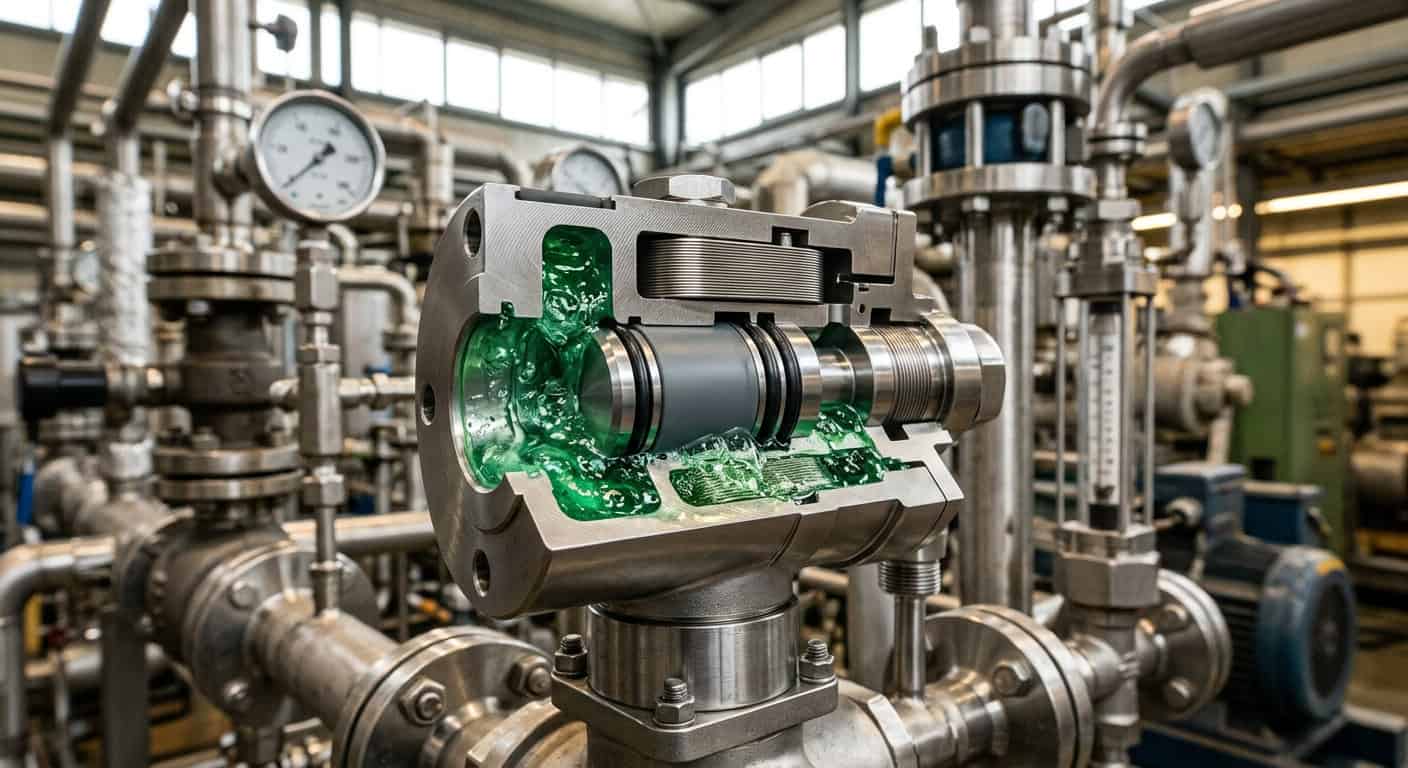
While many believe that simply replacing parts with stainless steel can solve corrosion problems, the truth is often harsher because “rust-proof” stainless steel is usually “non-magnetic.” This is like trying to use a magnet to pick up a plastic spoon; no matter how strong your magnetic force is, the spoon remains motionless. In electromagnet design, the SUS430 or SUS446 we commonly use has excellent magnetic permeability, but their resistance in strong acid environments is almost zero; conversely, SUS316L, which has excellent corrosion resistance, is a weakly magnetic or even non-magnetic material. There was once a control valve in a pharmaceutical plant whose casing looked as shiny as new, but after being disassembled, it was discovered that the internal plunger had swollen like waterlogged wood. This was because, in the early stages of design, there was an excessive pursuit of suction force, while the destruction of magnetic materials by media penetration was ignored. This is like buying a phone advertised as waterproof, only to have the charging port corrode after being soaked in seawater for a long time; no matter how beautiful the exterior is, it’s useless. When designing, we usually have to plate the surface of the plunger with a layer of Electroless Nickel or PTFE with a thickness of about 20μm to 50μm. Although this film will create a tiny air gap resulting in a suction drop of about 10%, it is the only line of defense to preserve the lifespan of the electromagnet.
The “Breathing” Effect of Seals: Why Expensive Materials Can Still Fail
The selection of seals is typically a tug-of-war between elasticity and chemical stability; it is not simply a matter of picking the most expensive option. You might wonder why we cannot just use the most expensive perfluoroelastomer (FFKM) to solve all problems. Honestly, there is a trade-off: while FFKM can resist almost all chemicals, its elastic recovery performs poorly at low temperatures, and its cost can be fifty times that of standard fluoroelastomer (FKM). Imagine running in the rain wearing a heavy, airtight raincoat; although the rain cannot get in, your internal sweat (condensation) cannot get out either. Electromagnets generate heat during operation, causing the internal air to expand. If the seal design does not account for this “breathing” effect, corrosive gases will be “sucked” into the coil chamber during cooling and contraction. When handling 30% concentration hydrochloric acid, the electromagnet plunger must be treated with a special coating because even corrosion-resistant stainless steel will have its surface passivation layer destroyed by the friction of the magnetic circuit opening and closing, leading to a threefold increase in the corrosion rate. This microscopic erosion-corrosion is the invisible killer that causes engineers the most headaches.
The Synergy of High Temperatures and Chemical Reactions: Heat Trapped Inside Explosion-Proof Enclosures
Compared to heat dissipation in standard environments, electromagnets in chemical equipment are often encapsulated in airtight explosion-proof enclosures, making heat dissipation extremely difficult. Based on experience, for every 10°C increase in ambient temperature, the lifespan of insulation materials is halved. This is like locking a mobile phone in a turned-off car on a hot summer day; even if the phone is not in use, the high temperature will cause the battery and circuit boards to age rapidly. Fluid temperatures at chemical sites can reach as high as 150°C, so the duty cycle of the electromagnet can no longer be set according to standard specifications. You might ask, why not increase the coil size to lower the temperature? The issue is that space in chemical equipment is usually limited, and a larger coil means a heavier plunger, which slows down response speeds. We must design a thermal isolation layer between the solenoid coil and the fluid, sometimes even utilizing the fluid’s own low temperature to cool the coil. This design logic is very similar to the heat exchange mechanism of a household water heater, except we are exchanging heat rather than moisture.
Choices in Practical Application: Deriving Design Specifications from Maintenance Frequency
While many believe that simply replacing parts with stainless steel can solve corrosion problems, the truth is often harsher because “rust-proof” stainless steel is usually “non-magnetic.” It is like trying to pick up a plastic spoon with a magnet; no matter how strong your magnetic force is, the spoon remains motionless. In electromagnet design, the commonly used SUS430 or SUS446 have excellent magnetic permeability, but their resistance in strong acid environments is almost zero; conversely, SUS316L, which has excellent corrosion resistance, is a weakly magnetic or even non-magnetic material. There was once a control valve in a pharmaceutical plant where the outer casing looked as shiny as new, but upon disassembly, the internal plunger was found to be swollen like waterlogged wood. This happened because, in the early design stages, suction force was pursued excessively while the damage caused by medium penetration to the magnetic material was ignored. It is like buying a phone advertised as waterproof, only to have the charging port corrode after being soaked in seawater for a long time; no matter how beautiful the exterior is, it is useless. When designing, we usually have to plate the surface of the plunger with a layer of electroless nickel or PTFE (Teflon) with a thickness of about 20μm to 50μm. Although this film creates a tiny air gap that reduces suction by about 10%, it is the only line of defense for preserving the electromagnet’s lifespan.
For corrosive fluids, prioritize checking the Pitting Resistance Equivalent Number (PREN) value of the parts in contact with the medium. For chemical environments, it is recommended that the PREN be greater than 33, and ensure that the volume expansion rate of the seals in that specific chemical is less than 5% to prevent the plunger from seizing.