
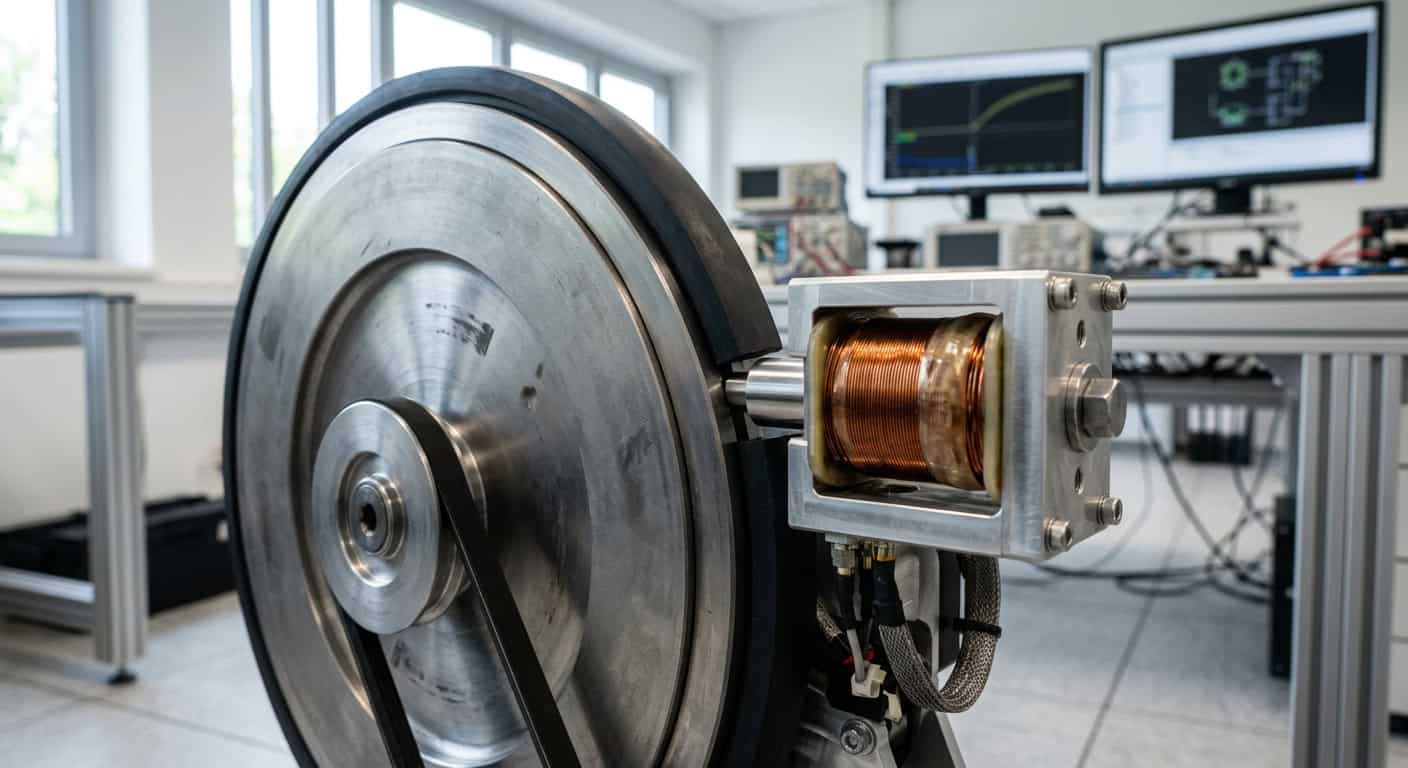
Many procurement personnel, when selecting resistance control components for fitness equipment, often only look at maximum attraction force and price, overlooking the subtle differences in dynamic response. Why is it that some magnetic flywheels in spin bikes feel like dragging on sand, while others are as smooth as an ice skate? The key lies not in the bearings, but in the electromagnet’s current and magnetic circuit design.
Pain Points in Fitness Equipment Resistance Control: Why Do Cheap Electromagnets Cause a Jerky Sensation?
A response delay of 30 milliseconds might be insignificant in industrial handling, but on a flywheel used for High-Intensity Interval Training (HIIT), it will cause users to experience a noticeable jerky sensation. When a rider rapidly changes pedaling frequency, the electromagnet must adjust its magnetic field strength in a very short time to provide corresponding resistance feedback.
We must admit that solely relying on software algorithms to compensate for hardware hysteresis often leads to more severe control oscillations. If the electromagnet core material is improperly selected, and the magnetic field cannot decay synchronously after the current is reduced, excess resistance will be generated. This is an inherent hardware defect.
Hysteresis and Residual Magnetism: The Invisible Killers Affecting Flywheel Feel
When the operating temperature of fitness equipment electromagnets exceeds 80 degrees Celsius, the residual magnetism of the magnetic circuit system must be controlled to less than 5% of the saturation magnetic flux density to ensure seamless transitions during resistance changes.
Imagine, when a user is sprinting at full effort, the resistance increases because the residual magnetism inside the electromagnet cannot be released in time, causing the pedaling sensation to suddenly become heavier. This not only affects the experience but may also cause sports injuries. This phenomenon, where magnetism still remains inside the core after the electromagnet is powered off or current is reduced, is the main reason for resistance “stickiness.”
Secrets Not Visible on the Specification Sheet: How to Evaluate the Linearity of Electromagnet Resistance Adjustment?
The linearity of electromagnet resistance adjustment determines the smoothness of resistance changes from level 1 to level 20 in fitness equipment. In low-end products, the output magnetic force of the electromagnet and the input current often show a non-linear relationship, leading to drastic changes in resistance in the mid-range and saturation in the high-resistance range.
Why do some devices perform normally at low resistance but experience stepped jumps in resistance once they enter a high-load state? This is usually because the magnetic circuit design of the electromagnet does not avoid the magnetic saturation zone, causing the magnetic force not to increase proportionally when the current increases.
| Evaluation Metric | Standard Electromagnet | High-End Fitness-Specific Electromagnet |
|---|---|---|
| Residual Magnetism Rate (Br/Bs) | > 12% | < 4% |
| Thermal Decay Rate (Continuous operation for 1 hour) | > 20% Resistance drop | < 5% Resistance drop |
| Linear Control Range | Only 40% – 70% Current range | 10% – 95% Full current range |
The Fatal Impact of Heat Generation on Electromagnet Resistance Stability
Compared to test data at room temperature, when the electromagnet operates continuously for more than 40 minutes and the coil temperature rises to 85 degrees Celsius, the resistance of the copper wire will increase by approximately 25%. This directly leads to a decrease in magnetic flux and a decay in resistance. Without a good heat dissipation structure and temperature compensation mechanism, users will find it becomes easier to pedal, which is unacceptable in professional training.
Three Core Technical Indicators to Demand When Purchasing Fitness Equipment Electromagnets
Two key physical properties—the coercivity of the material and the thermal balance of the duty cycle—are non-negotiable bottom lines when screening suppliers. Purchasing personnel should not only focus on static attraction force but should request suppliers to provide dynamic hysteresis curves (Hysteresis Loop) and thermodynamic simulation data.
Although using high-permeability, low-residual magnetism permalloy (Permalloy) or high-quality electrical steel will increase material costs by approximately 15% to 30%, this can completely solve the problem of residual resistance. When making procurement decisions, subsequent customer complaint costs and brand reputation must be taken into consideration.
- Dynamic Hysteresis Loop Width: The narrower the width, the lower the residual magnetism, and the smoother the transient response during resistance switching.
- Coil Temperature Rise Coefficient: Requires continuous power-on for 2 hours at rated voltage, with temperature rise controlled within 45 degrees Celsius.
- Magnetic Circuit Air Gap (Air Gap) Design: Precise air gap tolerance control (e.g., 0.15mm ±0.02mm) ensures resistance consistency during mass production.
How to Choose the Most Suitable Electromagnet Customization Solution for High-End Fitness Equipment?
In actual R&D projects, we often encounter clients holding standard product specifications but unable to tune the entire machine to achieve the desired feel. This is because the resistance system of fitness equipment is a coupled system comprising the flywheel, transmission belt, electromagnet, and controller, and optimizing a single component cannot represent the overall experience.
The fundamental way to solve this problem is to integrate the electromagnet and flywheel magnetic circuit into a unified simulation design. Shih Shin Technology (世僖科技)’s approach in similar cases is, through 2D and 3D electromagnetic field Finite Element Analysis (FEA), to accurately calculate the distribution of magnetic field lines at different speeds and currents for clients, thereby customizing the most ergonomically appropriate resistance curve.
Competition in high-end fitness equipment has shifted from mere functionality to ultimate sensory experience. Choosing a partner with a deep foundation in magnetic circuit design and material science is essential to eliminate jerkiness at the hardware source and achieve a truly smooth exercise feel.
It is recommended that the R&D team in the early stages of a project provides flywheel material and maximum speed data to conduct 1:1 magnetic circuit simulation tests to shorten the prototyping and adjustment cycle by 40%.


