
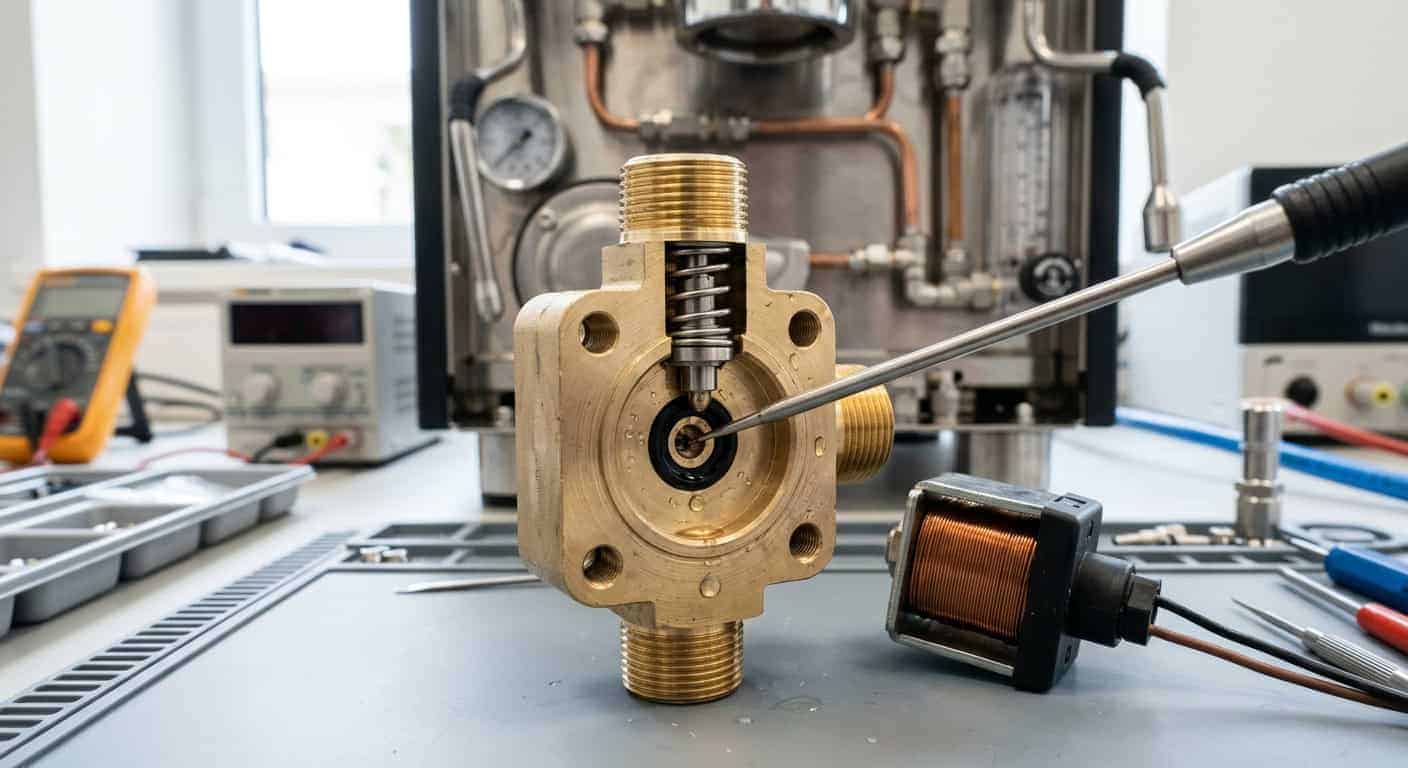
Many engineers assume unstable coffee machine extraction is due to insufficient pump pressure, but after disassembling several high-temperature failed units, we found that the problem often lies in residual magnetism generated by the solenoid valve due to high temperatures, causing the spool action to be delayed by a few tenths of a second.
Unstable Extraction Pressure? Debunking the Residual Magnetism Myth of Coffee Machine Solenoid Valves
Under frequent operation and high-temperature environments, the metal lattice of the plunger undergoes microscopic changes, thereby amplifying the residual magnetism effect.
Why do many solenoid valves advertised as high-temperature resistant start to show slight deviations in water output after continuously brewing 50 cups of coffee?
When the water temperature reaches above 92°C, the copper wire resistance of traditional electromagnets increases by about 30%, which directly leads to a decline in electromagnetic force, making the spring force, which could originally easily overcome residual magnetism, feel powerless.
In the past, the industry often believed that increasing spring preload could solve the problem of residual magnetic stickiness. However, this leads to the electromagnet requiring greater dynamic suction force during cold start-up, creating a vicious cycle of coil overheating.
Material Limits of High-Temperature Electromagnets: Why Teflon and Stainless Steel Are Not Panaceas
120°C saturated steam is the touchstone for material testing. Many designers blindly trust the corrosion resistance of stainless steel, yet overlook the physical limitation of extremely low magnetic permeability in austenitic stainless steel.
We must admit that in environments where extreme high temperatures and acidic water quality coexist, no single metal can currently satisfy the three conditions of high magnetic permeability, high hardness, and absolute rust resistance simultaneously.
We observed in tests that certain valve spools using Teflon (PTFE) coatings, after 100,000 reciprocal frictions, began to peel and get stuck in the micro-pores of the valve seat, leading to even more severe flow blockage.
- Magnetic Permeability Decay: For every 10°C increase in temperature, the saturation magnetic induction strength of soft magnetic materials shows a nonlinear decrease.
- Seal Thermal Deformation: Micro-deformation of fluoroelastomer (FKM) under high temperature and high pressure changes the starting point of the spool’s stroke.
- Dynamic Gap Change: Due to different thermal expansion coefficients, the mating tolerance between the valve body and spool shrinks at high temperatures, increasing mechanical friction resistance.
Key to Flow Control in Beverage Equipment: Dynamic Magnetic Circuit and Spring Compensation Design
The correct model for solving high-temperature flow fluctuations lies in establishing a dynamic magnetic circuit and a nonlinear compensation mechanism for spring force.
How to overcome the tradeoff between coil temperature rise and magnetic saturation in design?
Compared to the traditional approach of merely increasing the number of coil turns, modern designs lean towards optimizing the geometric shape of pole faces, utilizing conical poles to smooth the electromagnetic force output curve.
In high-temperature water systems, when the fluid temperature exceeds 95°C and the operating pressure is greater than 15 bar, the electromagnet must use electrical iron with low coercivity, combined with dynamic spring compensation, to ensure that the response time error for each opening and closing is controlled within 5 milliseconds.
A valve stroke of 2.0 mm may seem tiny, but under high pressure, the change in electromagnetic force over this distance is like stirring thick syrup in boiling hot water; any slight imbalance in torque will be amplified.
Commercial Coffee Machine Electromagnet Selection Guide and Customization Solutions
While standard products can meet the needs of most ambient temperature equipment, for demanding working conditions like commercial coffee machines with high frequency and high temperature, standard specifications often face degradation after half a year of operation.
Shih Shin Technology (世僖科技), in similar commercial beverage equipment projects, successfully helped clients reduce the impact of residual magnetism at high temperatures by 40% and significantly improved the stability of brewing flow by adjusting the magnetic circuit structure and introducing special annealing processes.
Precise flow control relies not just on strong electromagnetic force, but more critically on a deep understanding of material physical properties at high temperatures and fine-tuning of magnetic circuit details. Choosing a partner with a profound foundation in materials science and dynamic simulation capabilities is key to ensuring the long-term stable operation of beverage equipment.
It is recommended to provide the maximum operating temperature and expected pressure parameters of the water circuit at the initial design stage, allowing the engineering team to perform dynamic magnetic force simulations for you, preventing flow deviations caused by high-temperature residual magnetism.


