
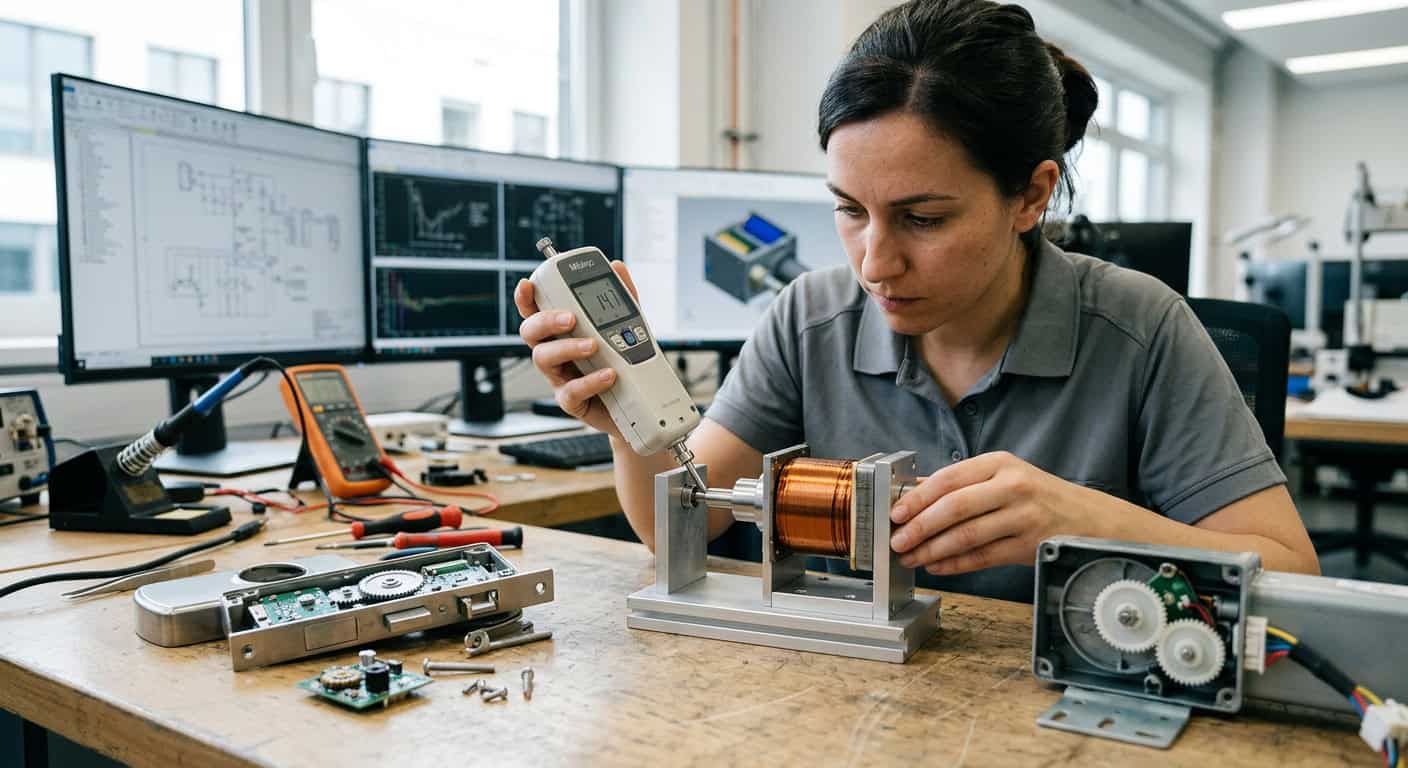
We have disassembled dozens of smart door locks returned due to jamming failures on-site, finding that up to 85% of these faults did not stem from chip failure, but rather from neglecting the physical limitations of mechanical lateral forces during solenoid valve specification selection. Many procurement teams, when selecting electromagnetic components for automatic curtains or smart locks, often only focus on static thrust and voltage, only to face the high cost of high return rates after product launch.
The “Static Thrust” Trap Most Easily Encountered When Selecting Smart Lock Solenoids
300,000 fault-free operations is the basic threshold for smart locks, yet many R&D engineers, when procuring, only look at the rated thrust in the specifications, ignoring the lateral resistance of over 5N caused by door panel deformation. When users push or pull the door panel or the door frame slightly deforms, the lock bolt will bear significant lateral shear force, leading to eccentric friction in the solenoid’s axis.
We must admit that simply increasing coil current to boost thrust is not a good strategy within the extremely limited space of a lock body. This directly leads to excessive temperature rise and a drastic reduction in battery life. It’s like pushing an eccentric revolving door with one hand; if the direction of the pushing force deviates slightly, the axis will jam, and any amount of force will just be wasted on internal friction.
Lateral Force and Lock Bolt Jamming: Why Can’t High-Thrust Solenoids Still Drive It?
In a failure analysis of smart lock solenoids, we found that when the accumulated installation tolerance of the lock body reaches 0.5mm, the friction coefficient of the sliding bearing instantly triples. At this point, even if the solenoid operates at a 12V full-load voltage, its output effective work cannot overcome the frictional resistance, preventing the lock bolt from retracting smoothly.
In the confined space of smart locks, when the lateral load exceeds 3N, solenoids with ball-guided structures have a lifespan more than three times greater than traditional sliding bearing structures.
How Do Automatic Curtain Solenoid Valves Avoid Heat and Noise During High-Frequency Use?
The operating environment for automatic curtains and shading systems is entirely different from smart locks; it requires longer single power-on times and extremely low operating noise. If a traditional push-pull solenoid is used, the coil must remain continuously powered to maintain the curtain’s open/closed state, causing the solenoid valve’s surface temperature to climb above 80°C within 10 minutes.
So, how can power consumption and heat generation be minimized while maintaining a locked state?
Conventional solenoids require continuous power to remain engaged, whereas bistable latching solenoids utilize the synergistic action of internal permanent magnets and electromagnetic coils, requiring pulse current only during the 50ms state transition. This design not only solves the heating problem but also reduces standby power consumption to near zero, making it ideal for battery-powered or temperature-sensitive smart home devices.
Key Differences Between Latching Solenoids and Bistable Designs in Power Saving
A 50% energy saving is just the starting point for bistable designs; more importantly, it completely eliminates thermal expansion caused by coil heating, thereby preventing noise generated by changes in mechanical component tolerances. In a quiet bedroom environment, any electromagnetic actuation sound exceeding 40dB will be considered a product defect by users, while bistable solenoids combined with buffer rubber pads can control noise below 30dB.
Three Core Parameters That Must Be Confirmed Before Procuring Smart Home Electromagnetic Components
Although many manufacturers claim their standard products can meet all needs, our actual comparison found that residual magnetism differences between different batches can be as high as 20%, which directly affects unlock response time. Residual magnetism refers to the magnetic force remaining in the iron core after the solenoid is powered off; if the residual magnetism is too high, the lock bolt will still be attracted after power-off, causing unlock delays or even failure.
When evaluating suppliers, procurement personnel should not just look at quotations but must request test data for key dimensions to ensure consistent quality during mass production.
| Evaluation Metrics | Smart Lock Solenoid Requirements | Automatic Curtain Solenoid Valve Requirements |
|---|---|---|
| Permissible Residual Magnetism | < 0.5 N (to avoid unlock delay) | < 1.0 N (allows greater tolerance) |
| Rated Temperature Rise Limit | < 15°C (to prevent the casing from becoming hot to touch) | < 30°C (continuous operation mode) |
| Actuation Noise Control | < 45 dB (instantaneous actuation) | < 35 dB (silent sliding) |
Custom Solenoid Evaluation Guide for Building High-Reliability Smart Door Locks and Curtain Systems
When assisting clients in optimizing smart door lock structures, we often recommend a two-pronged approach of mechanical load reduction and electromagnetic matching, rather than blindly procuring larger-spec solenoids.
Compared to common standard specifications on the market, Shih-Shin Technology (世僖科技)’s approach in similar cases is to limit residual magnetism to an extremely low range through precise electromagnetic simulation and material proportioning, and to provide customized solenoid solutions that meet specific space constraints. This customized service ensures that the solenoid maintains stable thrust output even at low voltages (such as 3V or 5V), while keeping power consumption in the optimal range.
Are you also troubled by the lifespan and power consumption issues of electromagnetic mechanisms in new smart home products? Choosing a partner with comprehensive test data and customization capabilities can help products avoid up to 90% of potential design flaws in the early stages of R&D, ensuring brand reputation after mass production.
It is recommended to provide mechanical lateral force and space constraint data in the initial design phase, allowing a professional team to complete a preliminary electromagnetic simulation evaluation within 48 hours, thereby reducing the risk of later mold modifications.


