
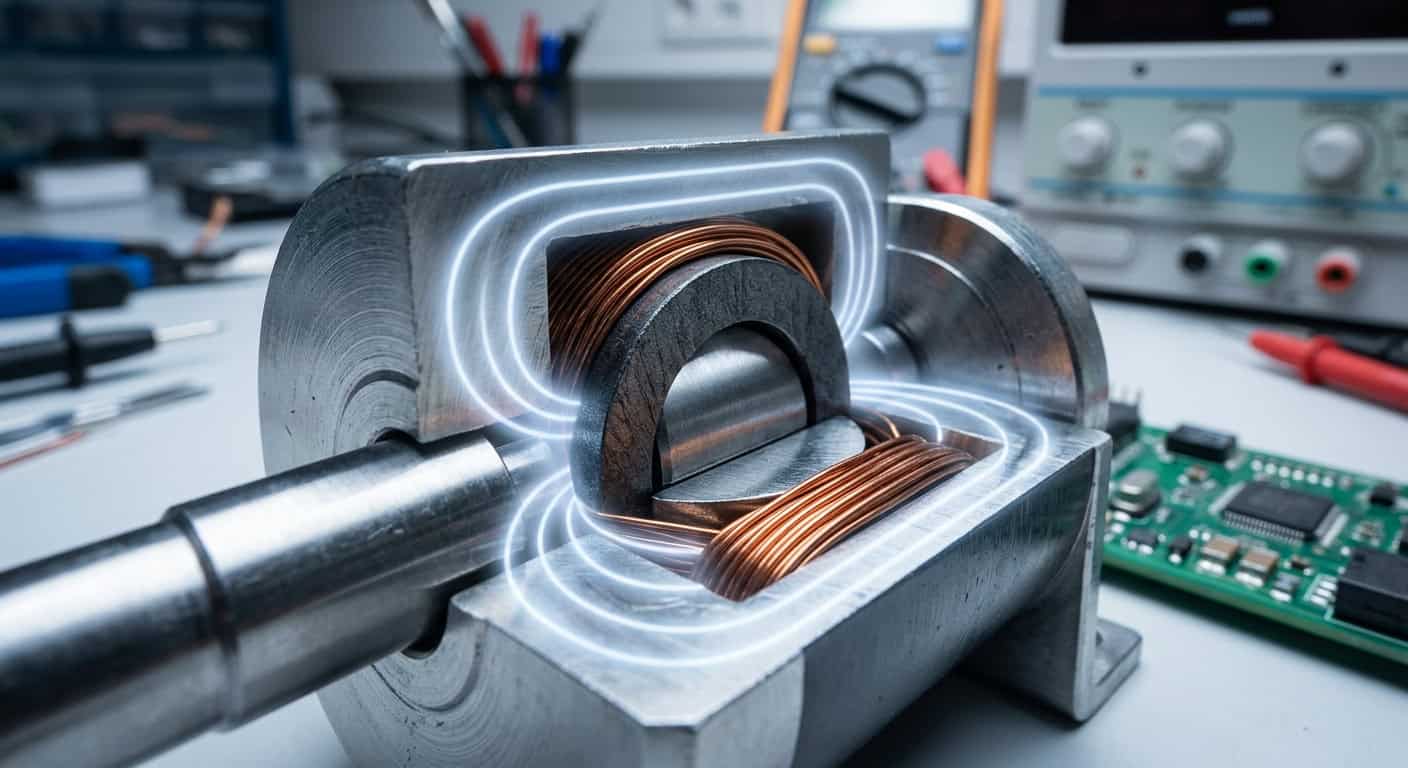
A standard solenoid continuously powered for 10 hours wastes 90% of its energy as heat, not useful work.
Why do we need continuous power to maintain a static mechanical state? When traditional monostable solenoids perform a “holding” action, the coil must be continuously energized to generate an electromagnetic force that counteracts spring return, leading to extremely low energy efficiency. For devices that need to maintain an open or closed state for extended periods, such as electronic door locks or industrial fluid valves, this continuous current load not only wastes electrical energy but also causes significant Thermal Drift, leading to a decrease in magnetic pull as temperature rises.
Behavioral Differences: Monostable vs. Bistable Solenoids
According to thermodynamic tests, when the coil temperature rises by 20°C, its resistance increases by approximately 8%, directly causing the Force Curve to shift downwards under constant voltage drive. Bistable technology (Latching Solenoid) uses an internally embedded permanent magnet to change the physical operating logic: current is only present momentarily during “state switching” (a 20-50ms pulse), while the state is maintained by the magnetic attraction of the permanent magnet. Below are the performance differences between the two designs under extreme holding conditions:
| Performance Metric | Standard Monostable | Pulsed Bistable (Latching) |
|---|---|---|
| Holding Power | 100% (Continuous Power) | 0% (Maintained by Permanent Magnet) |
| Coil Heat Rise | Significant, requires heat dissipation design consideration | Approaches ambient temperature |
| Power Failure Response | Immediate Reset (Fail-safe Position) | Maintains Current State (Position Memory) |
| Drive Circuit Complexity | Low (Unidirectional Switch) | Medium (Requires H-bridge for polarity reversal) |
Magnetic saturation and subsequent current increases do not linearly enhance attraction force; they only accelerate coil heating—a nonlinear critical point often overlooked during selection.
Design Limitations and Circuit Challenges of Adopting Bistable Technology
The precision of magnetic balance design determines product reliability. While bistable solenoids eliminate holding power consumption, they are highly sensitive to the width of the drive pulse and polarity switching. If the demagnetizing pulse is too strong, the core might be re-attracted by opposing magnetic force after release; if the pulse is too short, Residual Magnetism might not be effectively cancelled. This means that R&D must precisely calculate the air gap changes during the core’s stroke to ensure the magnetic balance point falls within the expected safe operating zone.
Admittedly, bistable is not a panacea; it has different requirements for safety after power failure. In the event of a power interruption, a bistable solenoid will lock into its last state, which could be a risk in some medical devices requiring “power-off fail-safe reset.” Therefore, designers must strike a balance between energy efficiency and fail-safe protection, rather than blindly pursuing low power consumption.
Specification Decisions for Long-Term Operation Scenarios
In applications such as smart warehousing or continuously open pneumatic valves, adopting a bistable solution can significantly extend battery life or reduce heat load within the cabinet. When addressing such customized requirements, SHIH JIAO Technology typically advises clients to first evaluate the Duty Cycle. If a single holding duration exceeds 30 seconds, the Return on Investment (ROI) for power savings by switching to a bistable solution will show exponential growth. We ensure consistent switching reliability of the pulse width across different ambient temperatures by optimizing the magnetic circuit distribution of the internal permanent magnet.
Actionable Recommendation: Prioritize checking electromagnetic components in the system with a Duty Cycle exceeding 50%. Evaluate whether the drive circuit has room for an H-bridge upgrade. Replacing monostable with bistable can directly solve over 70% of heat source issues.


