
TL;DR: Tubular solenoid and cylindrical solenoid are two names for the same construction: a linear DC solenoid whose coil sits inside a round steel shell that closes the magnetic circuit, giving minimal flux leakage and lower impact noise. An open frame solenoid is structurally different: the coil sits in a stamped steel bracket, which costs less but leaves the magnetic loop partly open. When you compare catalogs, ignore the naming and the digits in part numbers (the SH-T1939 measures 20.4 mm across, not 19). Match drawing dimensions, mounting interface, watts at 20°C at the same duty cycle, coil resistance, and force at your working stroke.

Ask three suppliers for a “cylindrical solenoid” and you may get three different-looking quotes: one for a tubular solenoid, one for an open frame part, and one clarifying question. The confusion is not your fault. The industry never standardized these names, and every catalog draws the lines a little differently. This guide sorts out what the terms mean, where the real structural differences sit, and how to compare specifications across catalogs that refuse to use the same words.
Tubular and Cylindrical Are the Same Part
Start with the easy one: a tubular solenoid and a cylindrical solenoid are the same device. Both names describe a linear DC solenoid whose coil sits inside a round steel shell. The shell does double duty as housing and magnetic return path, so the flux loop closes around the full circumference of the coil. Some catalogs call this construction tubular, others cylindrical, and you will also see “enclosed” or “can type” used for the identical thing. Shih Shin datasheets use Tubular Solenoid, with model numbers prefixed SH-T.
The practical consequence: when you source this construction, run searches under both names. A supplier that indexes the part as cylindrical will not surface under a tubular query, and the part you cannot find is often just filed under the other word.
Open frame is not a third synonym. It names a genuinely different construction, and that difference is where a real comparison starts.
What the Construction Actually Changes
An open frame solenoid carries its coil in a stamped steel bracket with the windings visible. The frame closes the magnetic circuit on some sides but leaves part of the loop open to air. A tubular solenoid encloses the same coil in a round steel shell that closes the circuit in every radial direction. That single difference drives most of the practical trade-offs:
| Attribute | Open frame | Tubular (cylindrical) |
|---|---|---|
| Construction | Coil on a bobbin inside a stamped steel frame; windings exposed | Coil enclosed in a round steel shell; shell forms the magnetic return path |
| Flux leakage | Higher; the magnetic loop is partly open | Minimal; the closed shell keeps flux inside the case |
| Impact noise | Higher relative to tubular types | Lower impact noise |
| Cost tendency | Lower; stamped frame, simple assembly | Higher; the shell and threaded bushing add operations |
| Typical frame sizes | 8 x 10 x 15 mm body at 5.4 g (SH-0415) up to a 37 x 41 mm frame with 51 mm body at 315 g (SH-1250) | Ø11.2 x 30 mm body at 17 g (SH-T1130) up through the SH-T3864, across seven sizes |
Source: SH-0415, SH-1250, SH-T1130 datasheets, Shih Shin Technology. Values are for reference and subject to design revision.
Flux leakage matters when the solenoid sits near reed switches, Hall sensors, or magnetic encoders. Impact noise matters in office and medical equipment. Cost matters everywhere, which is why open frame stays the default in high-volume actuation where neither constraint applies. If your application is noise- or field-sensitive, the tubular construction earns its price; if not, you are paying for containment you do not need.
Frame Size Codes Do Not Mean What They Look Like
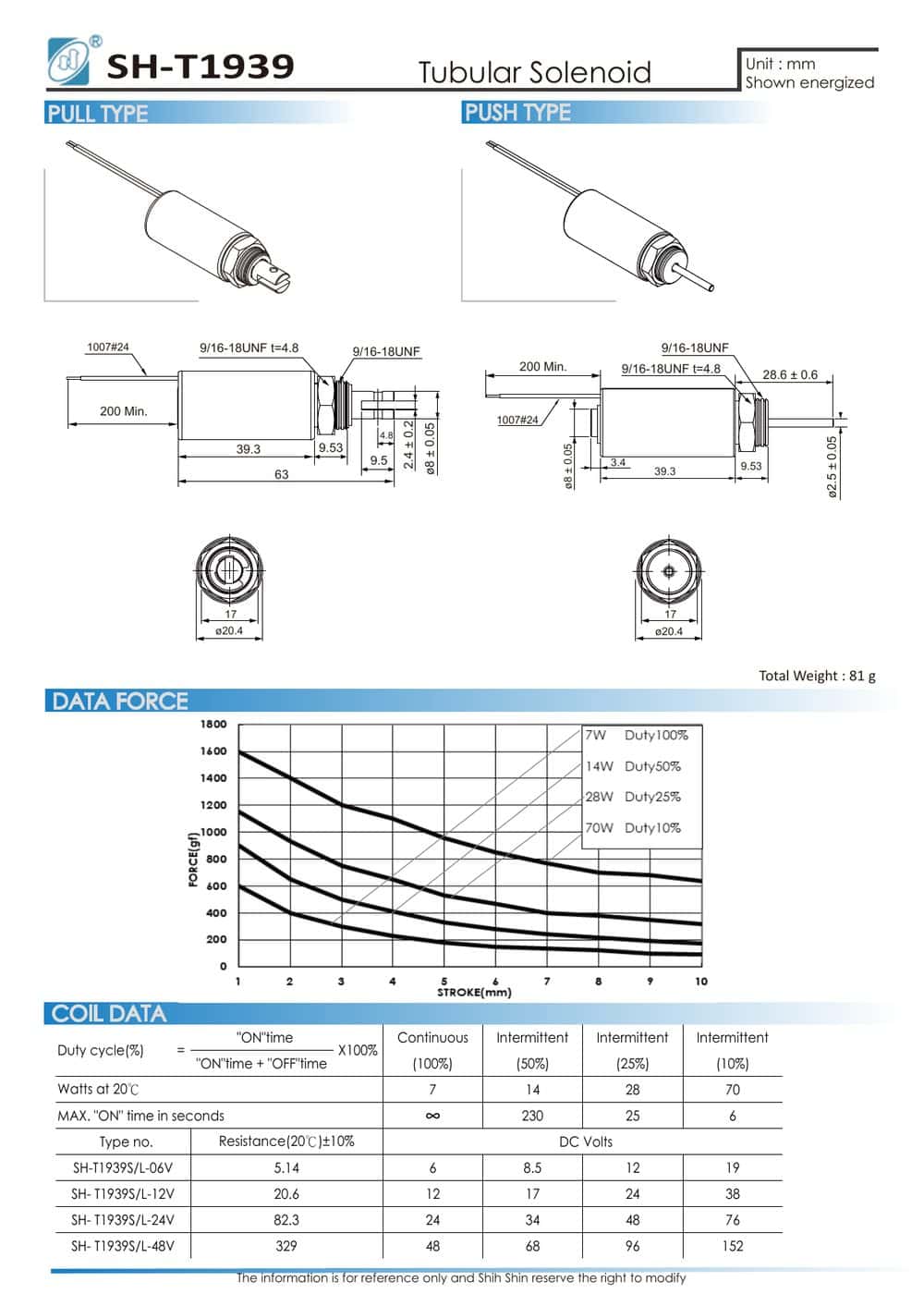
The fastest way to get burned comparing catalogs is to read dimensions out of model numbers. Take the SH-T1939. The digits suggest a 19 mm diameter, and other makers code their parts the same way. The drawing tells another story: maximum body diameter is 20.4 mm, body length is 39.3 mm, and the pull type runs 63 mm overall with the plunger extended. A panel cutout sized to the literal 19 will not accept the part.
Length quoting is the second trap. The SH-T1130 has a 30 mm maximum body length but measures 42.3 mm overall in pull configuration once the threaded bushing and plunger are counted. One catalog quotes the body, another quotes the envelope, and at a glance the two read as different parts.
Mounting interfaces split cleanly by construction. Tubular types mount through a panel on a threaded bushing: 5/16-32UNF on the SH-T1130, 9/16-18UNF on the SH-T1939. Open frame types mount flat on tapped holes in the frame: four M2 holes on the SH-0415, eight M3 holes on the SH-1250. Swapping one construction for the other changes your bracket, and that cost belongs in the comparison too.
The rule: pull the mechanical drawing and compare maximum outside diameter or frame width and height, body length, overall length, and mounting interface. Part number digits are nominal at best.
Reading a Coil Table the Same Way Across Suppliers
Wattage is where cross-catalog comparison usually goes wrong, because rated power means nothing without its duty cycle. Here is the published coil table of the SH-T1939:
| Duty cycle | Continuous (100%) | Intermittent (50%) | Intermittent (25%) | Intermittent (10%) |
|---|---|---|---|---|
| Watts at 20°C | 7 | 14 | 28 | 70 |
| Max. “ON” time | No limit | 230 s | 25 s | 6 s |
Source: SH-T1939 datasheet, Shih Shin Technology. Values are for reference and subject to design revision.
The same physical part is legitimately a 7 W solenoid and a 70 W solenoid. Some catalogs print the 10% duty figure because it reads stronger; others quote continuous. Before you conclude one vendor’s part outperforms another, check which duty column the wattage came from, then compare watts at 20°C at the same duty cycle along with the maximum ON time that goes with it.
Coil resistance is the cleanest cross-check because it describes the winding directly. The 6 V winding of the SH-T1939 measures 5.14 Ω at 20°C with a ±10% tolerance; the 24 V winding measures 82.3 Ω. Two catalogs listing materially different resistance for “the same” part are describing different windings. Total weight works as a checksum for the magnetics: the SH-T1939 weighs 81 g, and a candidate replacement far off that figure almost certainly differs in steel or copper content.
Force deserves the same discipline. Compare force at your working stroke, read from the force-stroke curve at matching duty cycle, rather than the single peak value some catalogs print.
Cross-Reference Checklist, Then a Quote
Before you send an RFQ against another maker’s part number, collect five data points:
- Drawing dimensions: maximum OD or frame width and height, body length, and overall length in your configuration (pull or push).
- Mounting interface: bushing thread size for tubular, tapped-hole pattern for open frame.
- Watts at 20°C at the same duty cycle, plus the maximum ON time for that duty.
- Coil resistance and rated voltage for the specific winding.
- Force at working stroke, read from the curve at the duty cycle you will actually run.
Work through those five in order and most naming confusion resolves itself. If you are matching an existing part from another catalog, start with the solenoid cross-reference lookup. For a first pass at candidate sizes, the full product range spans 20 open frame models from the SH-0415 upward and seven tubular models from the SH-T1130 to the SH-T3864. Every figure in this guide comes straight from the published datasheets, per our editorial process.
When you have the five data points, email them to info@solenoids.com.tw with your target quantity and application notes. An engineer reviews the fit against both constructions and typically replies within 24 to 48 hours on business days.
Frequently Asked Questions
Is a tubular solenoid the same as a cylindrical solenoid, or are they different parts?
They are the same part. Both names describe a linear DC solenoid with the coil enclosed in a round steel shell that forms the magnetic return path, which is why this construction shows minimal flux leakage and lower impact noise than open frame types. Naming varies by supplier catalog, so search under both terms and confirm against the mechanical drawing rather than the family name.
Two catalogs list different wattages for what looks like the same solenoid. Which number do I trust?
Probably both. Rated watts change with duty cycle: the SH-T1939, for example, is rated 7 W continuous but 70 W at 10% duty with a 6 second maximum ON time. Compare watts at 20 degrees C at the same duty cycle, and use coil resistance (5.14 ohms for its 6 V winding) to confirm you are looking at the same winding.


