
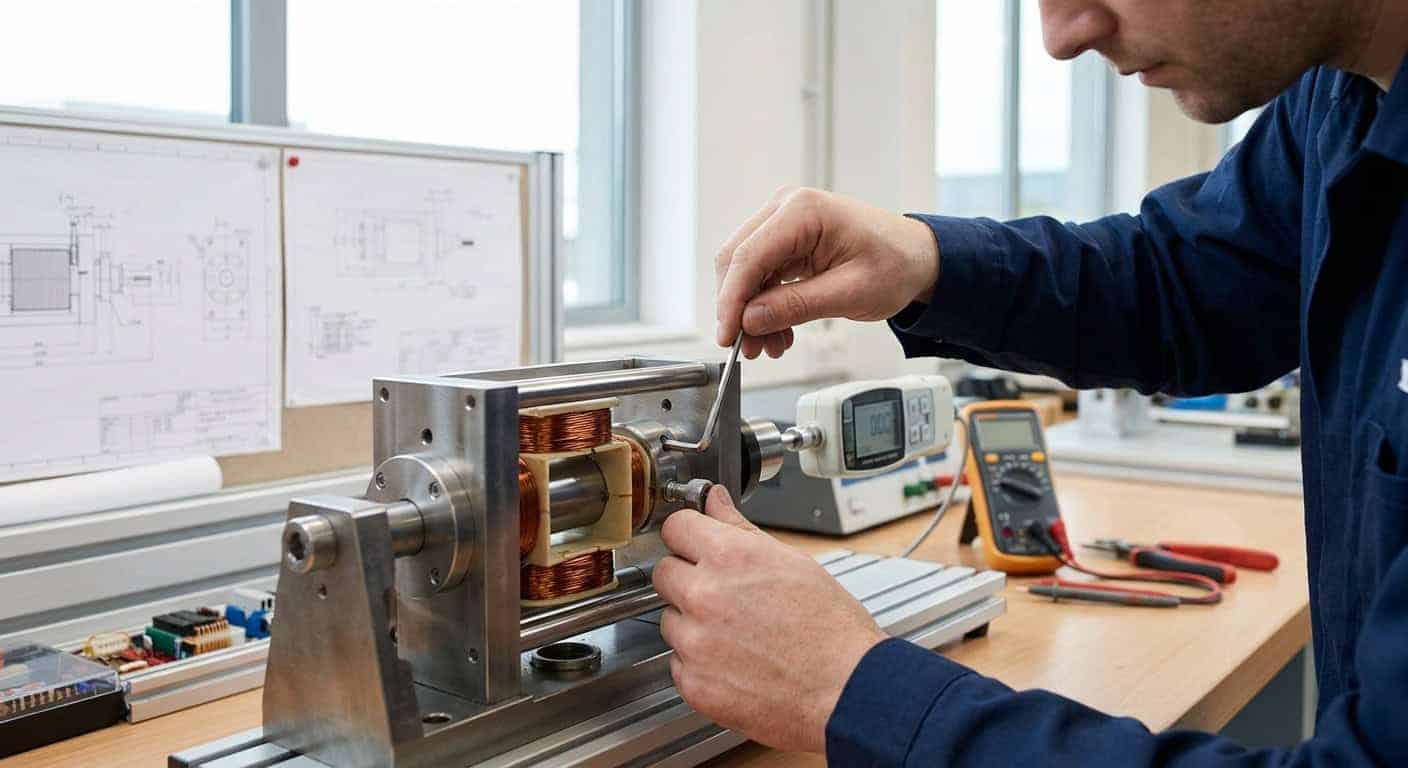
Even though the voltage is sufficient and the suction force data in the specifications looks good, why can’t the electromagnet hold even half a kilogram of load after being installed on the machine?
The Unspoken Secret in Specifications: Why Electromagnet Suction Force Decreases On-Site?
However, many purchasers and engineers often encounter the dilemma of static suction force not matching dynamic suction force during testing.
When the coil temperature of a 24V rated voltage rises to 85°C, the actual electromagnet suction force produced can be halved.
We must admit that simply looking at the maximum suction force in the specifications is the most common cause of subsequent design failures.
The Invisible Killer: Operating Voltage and Coil Temperature Rise
When we disassemble failed samples returned by customers, we find that the coil’s resistance has increased due to prolonged energization, leading to a significant drop in current.
Electromagnet suction force is directly proportional to the current magnitude, and not an absolutely direct relationship with voltage.
The Critical Electromagnet Air Gap: How Micron-Level Errors Determine Suction Success or Failure
Why can an electromagnet air gap of just 0.5mm cause an original 10kg suction force to instantly drop to only 1kg?
Compared to a tightly fitted state, the permeability of air (Permeability) is extremely low, like inserting a huge resistance pad into the magnetic circuit.
Even a tiny surface roughness or micro-dust can cause significant leakage of magnetic flux lines in extreme adsorption applications.
We must admit that when the working air gap is greater than 1.5mm, the magnetic circuit efficiency of the electromagnet will drastically decrease. At this point, the marginal effect of increasing coil turns on improving suction force will be less than 15%. Priority should be given to changing the mechanical stroke rather than blindly increasing power.
In the tests we handled, an assembly deviation of merely 0.1mm was enough to cause the qualification rate of the entire batch of equipment to fall below 80%.
| Air Gap Size (mm) | Relative Suction Retention (%) | Recommended Application Scenarios |
|---|---|---|
| 0.0 (Fully fitted) | 100% | Hold and lock |
| 0.5 | 35% | Short-stroke triggering |
| 1.5 | 8% | Requires mechanical compensation |
Permeable Materials and Residual Magnetism: Material Secrets Affecting Electromagnet Suction Performance
The permeability of electromagnet materials determines their ability to concentrate magnetic flux lines; the magnetic permeability of low-carbon steel and stainless steel differs greatly.
If current is blindly increased to solve suction problems, will it lead to more serious residual magnetism (Residual Magnetism) retention issues?
But in reality, when the power is cut off and the iron core remains tightly adsorbed and cannot be released, this is residual magnetism at work, which must be solved through material heat treatment or demagnetization design.
How to Avoid Wrong Purchases? Shih-Shin Technology (世僖科技)’s Electromagnet Selection Guide
3 key steps can help you complete precise electromagnet selection early on and avoid repeating mistakes.
- Confirm dynamic working air gap and stroke range
- Calculate coil resistance change at extreme operating temperatures
- Evaluate the material and contact surface flatness of the adsorbed object
We must admit that no single electromagnet can simultaneously meet the perfect requirements of unlimited energization, ultra-high suction, and zero temperature rise; engineering design is inherently the art of compromise.
Shih-Shin Technology (世僖科技)’s approach in similar cases is to first clarify the dynamic working air gap, and then match the most suitable coil specifications based on the temperature rise curve.
The suction force of an electromagnet is never a static number, but rather the result of a collective compromise between voltage, air gap, and material under dynamic operation. Only by considering temperature rise and mechanical tolerances in the initial design can the equipment remain stable and reliable under long-term operation.
It is recommended to provide working cycle and air gap data to the engineering team in the initial design phase to obtain an accurate simulation evaluation within 24 hours.


