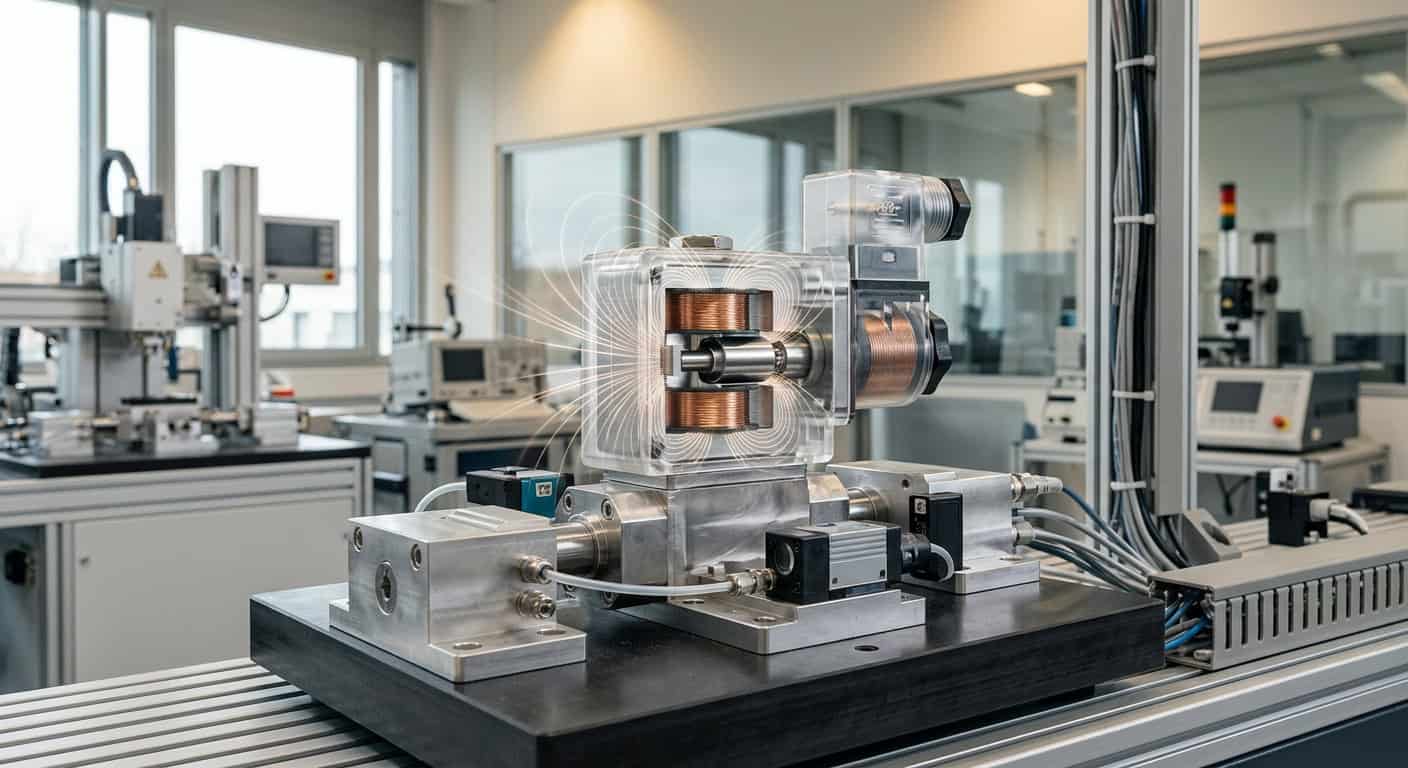
A reaction time of 20 milliseconds might seem perfect in laboratory data, but on a production line operating 500 times per minute, this means the internal piston will strike the casing 30,000 times per hour. Many purchasers, when selecting industrial automation solenoid valves, habitually prioritize reaction speed, believing that a fast enough switch is a good product. However, what isn’t visible on the drawing is the mechanical fatigue and heat accumulation hidden behind such extreme impact.
Why Does Over-Pursuing Reaction Speed Shorten the Lifespan of Automation Equipment?
We must admit that excessively pursuing extreme speed often sacrifices mechanical lifespan, leading to fatigue damage in equipment within less than half a year of operation. When electromagnetic force (Electromagnetic Force) erupts instantaneously, the moving core, lacking buffering, will strike the stationary core with extremely high kinetic energy. This metal-on-metal impact not only generates high-decibel noise but also causes plastic deformation of the sealing surface. Once the sealing surface is damaged, air leakage becomes an unavoidable chain reaction, ultimately leading to the shutdown and maintenance of the entire automation equipment.
Engineering Insight: In high-speed reciprocating motion, choosing solenoid valves with internal buffering designs or moderate energization rate limits results in a total cost of ownership (TCO) far lower than models that solely pursue millisecond-level speeds.
- Kinetic Impact: Doubling the speed quadruples the impact energy.
- Heat Loss: Eddy current losses generated by high-frequency switching cause the coil temperature to rise rapidly.
- Seal Wear: Frequent high-pressure impacts accelerate the hardening and cracking of rubber seals.
In an automation cabinet where ambient temperature exceeds 60°C, every 10°C increase in solenoid valve coil temperature theoretically halves the insulation lifespan. This requires designers to re-evaluate the permissible range of the energization rate. If your production line needs to operate 24 hours a day without interruption, the weighting of stability and heat dissipation efficiency should rightly be higher than a few milliseconds of speed difference.
Direct-acting Solenoid Valve vs. Pilot-operated Solenoid Valve: Selection Logic in Pressure Environments
In a low-pressure test environment, a pilot-operated design might not be able to actuate at all, as it relies on the medium’s own pressure to assist in switching. Many engineers mistakenly believe that since pilot-operated solenoid valves (Pilot-operated Solenoid Valve) can handle large flow rates, they must be a superior choice. However, this overlooks the physical limitation of the minimum pressure differential (Minimum Pressure Differential) required for actuation. If the system pressure is below 0.5 bar, the internal diaphragm of the pilot valve cannot be effectively expanded, leading to sluggish operation or even failure.
The true key lies in the balance between fluid pressure and flow demand. Although direct-acting solenoid valves (Direct-acting Solenoid Valve) have a smaller port size, they can operate independently of system pressure, making them very suitable for vacuum (Vacuum) or low-pressure gravity flow environments. Simply put, direct-acting valves rely on electromagnetic force for direct pulling, while pilot-operated valves “leverage force” using electromagnetic force. The former excels in zero-pressure actuation, while the latter excels in handling larger diameter pipelines with a smaller initial force.
| Characteristic | Direct-acting Solenoid Valve | Pilot-operated Solenoid Valve |
|---|---|---|
| Actuation Pressure Differential Requirement | 0 bar (Zero-pressure actuation) | Usually requires > 0.3 – 0.5 bar |
| Flow Coefficient (Cv) | Smaller, limited by electromagnetic force | Larger, can drive large diameter |
| Response Time | Extremely fast, direct linkage | Slightly slower, requires internal pressure build-up |
| Suitable Medium | Clean gases, liquids | Requires filtration, to prevent pilot orifice clogging |
Why do some systems frequently malfunction after upgrading to higher-spec valves? This is usually due to neglecting the cleanliness of the medium. The tiny pilot orifices (Pilot Orifice) inside pilot-operated valves are extremely sensitive to impurities; even minute metal shavings or gummy substances can lead to pressure relief failure, causing the valve to get stuck in the open or closed position, which is a fatal risk in precision automated assembly lines.
Solving Residual Magnetism Issues: Precision Control under High-Frequency Switching
Although soft iron material has good magnetic conductivity, if not professionally annealed, accumulated residual magnetism (Residual Magnetism) will significantly reduce accuracy. When the current is cut off, the magnetic field does not immediately disappear to zero. This residual attractive force can drag the moving core, causing a release delay after power-off. You can imagine it like an expired but still sticky note; even if you let go, it still clings to your fingertips, refusing to drop.
3 common solutions include adding non-magnetic shims, adjusting the return spring pressure, and selecting high-quality magnetic circuit materials. In dispensing or sorting applications requiring extremely high repetitive accuracy, such millisecond-level delays can lead to a decrease in product yield. We have observed that many low-cost solenoid valves omit magnetic circuit optimization procedures to save costs, leading to residual magnetic effects becoming more uncontrollable after several hours of continuous operation as the temperature rises.
Establishing a Decision Framework for Industrial-Grade Solenoid Valve Selection Standards
We also observe that environmental adaptability is often overlooked in procurement decisions. In chemical automation environments containing oil mist or corrosive gases, the coil’s encapsulation rating (IP Rating) and the selection of valve body material are far more important than electrical parameters. If a non-corrosion-resistant aluminum alloy valve body is chosen to handle corrosive fluids, even with strong electrical performance, internal leakage will occur within a few weeks due to valve seat corrosion.
When dealing with such complex selection recommendations, Shih-Shin Technology (世僖科技) requires clients to first confirm three core dimensions: operating pressure range, ambient temperature fluctuations, and expected cycle count. This is not to increase procurement difficulty, but to ensure that in complex magnetic circuit designs, through the optimization of material science and mechanical tolerances, the impact of residual magnetism can be minimized, and accidental failures can be prevented within the expected service life.
True selection wisdom lies not in buying the most expensive, but in buying what is most suitable for the physical limitations of the application scenario. Only when you understand the interplay between electromagnetic force, fluid pressure differential, and material science can you avoid those seemingly perfect but actually fragile technical pitfalls during the automation upgrade process and establish a truly robust production system.
It is recommended that before finalizing the selection, suppliers be asked to provide residual magnetic displacement test data after at least 1 million cycles, ensuring that the precision deviation during long-term operation is less than 5%.