
TL;DR: Qualify an automotive solenoid manufacturer in three passes. First, sample validation: confirm prototype samples come from production-intent tooling and get the differences from series production stated in writing. Second, environmental testing: ask which test types, such as temperature cycling, vibration, and voltage transient checks, run in-house versus at outside labs, and request a past test report. Third, documentation: a complete datasheet with a force-stroke curve, coil data, and a revision-controlled drawing is the cheapest maturity signal you can check before an RFQ. Put change-control and traceability commitments in writing before tooling money is committed. The checklist below lists the questions to ask and the red flags that should push a supplier off your shortlist.
Most automotive solenoid catalogs look alike. Coil voltage, force at stroke, duty cycle: the numbers sit in similar tables, and the real differences between manufacturers only show up during validation, after tooling money is committed. This guide is a qualification checklist for purchasing engineers shortlisting an automotive solenoid manufacturer before RFQ. We build solenoids in Taiwan, and custom OEM programs make up about half of our production, so the checklist reflects the questions serious customers ask us, and the answers a mature factory should have ready.
Start With the Sample Validation Path
A workable validation path has three stages, and the transitions between them are where programs fail. Prototype samples prove the concept: force in the right range, envelope fits, coil within the electrical budget. Design validation testing follows, on your bench and against your OEM’s environmental specification. Production consistency is the stage most shortlists skip: a pilot run built on production tooling, production winding equipment, and the production line, measured against the same acceptance criteria as the approved samples.
The single most useful question in supplier qualification: ask the manufacturer to state in writing what will differ between the sample build and series production. Hand-wound coils, different encapsulation batches, and temporary fixtures are all normal at prototype stage. What matters is whether the factory tracks those differences and closes them before release. A supplier who answers “nothing changes” without qualification has usually not thought about the question. One who lists the differences, and the pilot-run plan that retires them, has run OEM programs before.
Environmental Testing: Ask for Test Types, Then Evidence
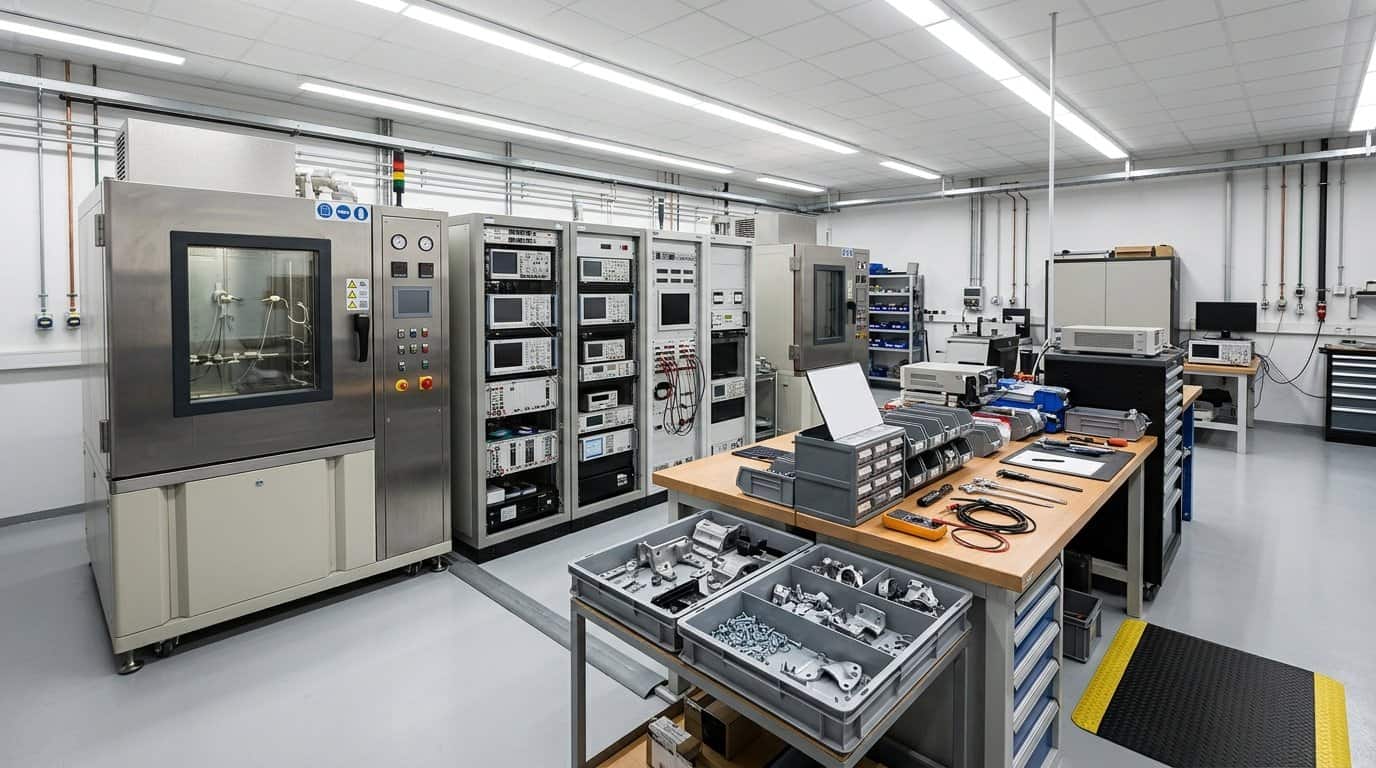
Your OEM specification defines the limits; the manufacturer’s job is to build to them and show evidence. So skip “are you certified” and ask capability questions instead. The test types that matter for automotive solenoids:
- Thermal: temperature cycling plus operation at high and low temperature extremes, because coil resistance and output force both move with temperature.
- Mechanical: vibration and mechanical shock, run in a fixture representative of the mounting position in the vehicle.
- Electrical: operation across the supply voltage band and behavior under voltage transients from the vehicle electrical system.
- Endurance: actuation cycling to your rated life, with force checked before and after.
For each type, ask the manufacturer which tests run in-house, which go to outside labs, and what a finished report looks like. Request a sample test report from a past program; redacted customer data is fine. Treat one answer as an immediate red flag: a supplier who promises to pass every test before reading your specification. The supplier who asks for your test matrix early is the one taking it seriously.
Read the Datasheet Before You Read the Quote
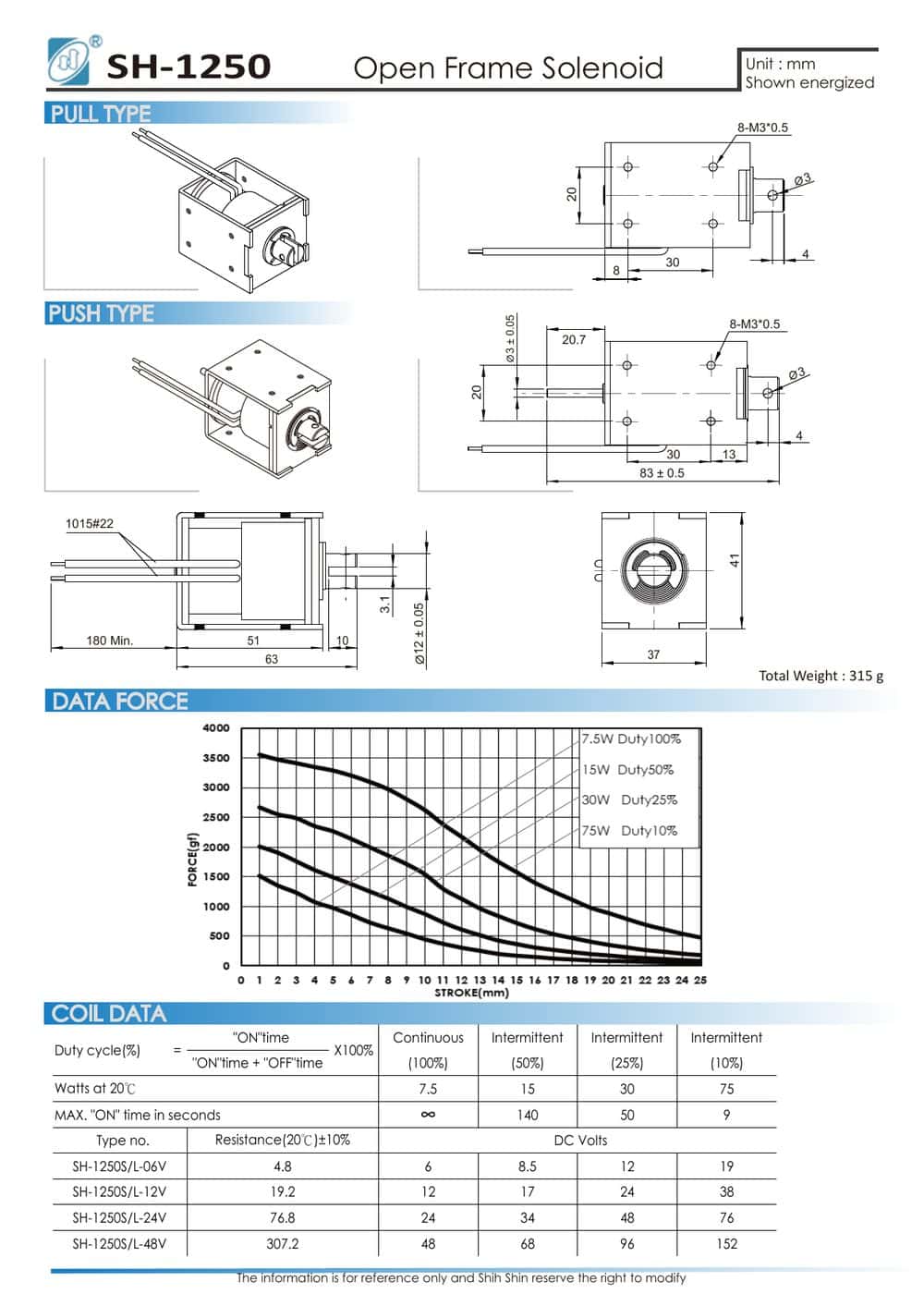
Documentation completeness is the cheapest maturity signal you can check, and you can check it before the first phone call. Pull the supplier’s published datasheets and look for three things: a force-stroke curve rather than a single force number, coil data including rated voltage and resistance, and a dimensioned drawing under revision control. A factory that cannot produce this for its own standard parts will struggle with the approval paperwork your quality team requires on a custom program.
We hold ourselves to that standard: each of our 44 standard models across five product families has a published datasheet with dimensional drawings and performance data (force-stroke curves for linear solenoids, holding-force tables for electromagnets). Browse the industrial solenoid product range to see the format, and if you are second-sourcing an existing part number, the solenoid cross-reference page is the faster starting point. Published values on this site are maintained under a documented editorial process.
Two follow-up questions worth asking about any datasheet: is the force curve measured or calculated, and at what coil temperature and duty cycle was it taken? The answers tell you how the factory treats its own data.
The OEM Qualification Checklist
Use this table during supplier calls. The middle column is what to ask; the right column is what should push a candidate down or off the shortlist.
| Evaluation area | What to ask | Red flag |
|---|---|---|
| Sample build | Are prototype samples built on production-intent tooling and winding equipment? If not, what differs? | Hand-built samples with no stated differences from series production |
| Force data | Is the force-stroke curve measured or calculated? At what coil temperature and duty cycle? | A single force number with no stroke, temperature, or duty-cycle context |
| Environmental testing | Which test types (temperature cycling, vibration, voltage transients, endurance) run in-house, and which go to outside labs? | A promise to pass every test before your specification has been read |
| Production consistency | What is checked on every unit in-line, what is sampled, and can I see pilot-run data from a past program? | Final visual inspection only, with no in-process electrical checks |
| Change control | How are material, winding, or process changes communicated after approval, and how far in advance? | No written change-notification commitment |
| Traceability | Can a field return be traced back to winding lot and build date? | No date or lot coding anywhere on the drawing |
| Engineering communication | Who answers technical questions during validation, and in what time zone and language? | Every technical question routes through a sales-only contact with no path to engineering |
Source: Shih Shin Technology supplier qualification guidance, compiled from OEM program experience. Items are for reference and subject to revision.
Where Taiwan Fits in Your Sourcing Map
Evaluate Taiwan-based suppliers on structural factors, not country-of-origin sentiment. The factors that actually affect a program: engineering communication (whether your design engineers can talk directly with the people who design and wind the coils, in English, without a translation layer), customization willingness (at Shih Shin, custom OEM designs account for about half of production, so a modified plunger or a nonstandard coil is routine work rather than an exception), and continuity (ask any supplier, in any country, for stated sample and production lead times in writing, and for how they handled allocation during past component shortages).
None of this replaces the checklist above. A Taiwan entry on your shortlist should be scored the same way as any other: on validation discipline and documentation first, with logistics as the secondary factor.
Next Step: Send One Part, Not a Questionnaire
A questionnaire tells you what a supplier says; a part tells you what they do. Pick one solenoid position from a current program and send the drawing, or the basic parameters: stroke, force point, supply voltage, duty cycle, and ambient temperature range. Then watch what comes back. Clarifying questions are a good sign. An instant yes is not.
If you want to run that test on us, send the details to info@solenoids.com.tw. Replies typically go out within 24 to 48 hours on business days, with a feasibility read and the questions we need answered before quoting.
Frequently Asked Questions
How do I make sure production solenoids will match the samples I approved?
Do not rely on the sample alone. Ask the manufacturer to state in writing what differs between the sample build and series production, including tooling, winding equipment, and encapsulation. Require a pilot run from the production line, measured against the same acceptance criteria as the approved samples, before release. In-process checks such as coil resistance measurement on every unit tell you more about consistency than final inspection does, and keeping approved reference samples on both sides gives you an anchor for any later dispute.
What documentation should I expect from a solenoid manufacturer before sending an RFQ?
At minimum: a datasheet with a force-stroke curve rather than a single force number, coil data including rated voltage and resistance, and a dimensioned drawing under revision control. Then ask which environmental test types, such as temperature cycling, vibration, and voltage transient checks, the factory can run in-house versus at outside labs. If documentation for standard catalog parts is thin, expect the approval paperwork on a custom program to be thinner.


