
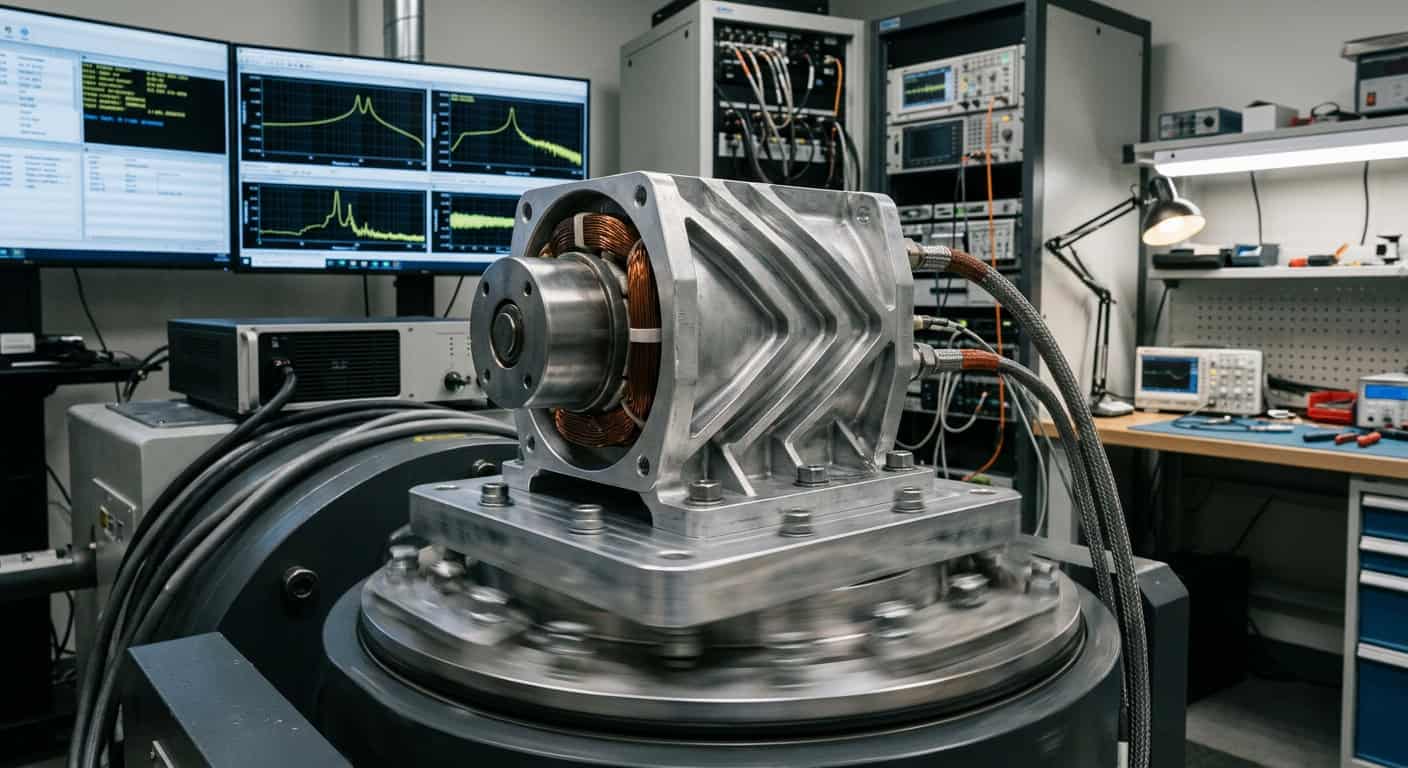
It is acknowledged that electromagnets performing perfectly in laboratory static tests often exhibit unexplained sluggish actuation or seizing after three years of installation in military off-road vehicles or avionics bays. This phenomenon is usually unrelated to initial pull force, but is rather the combined effect of mechanical fatigue and magnetic degradation in extreme environments.
Mechanical Fatigue Analysis of Automotive-Grade Solenoids Under Vibration Environments
Imagine components installed near engine compartments or transmissions subjected to thousands of micro-vibrations per minute, as if countless miniature hammers were striking internal parts. This high-frequency vibration causes micron-level wear between the stainless steel guide tube and the plunger, destroying the original surface treatment. Why does the stroke shorten after three years despite adequate lubrication? The issue is that the coefficient of friction in a static environment and the frictional torque under dynamic vibration are entirely different matters; vibration induces centrifugal loss of lubricating grease. In 15G random vibration testing, if the guide sleeve hardness is below HRC 50, the wear rate increases exponentially, and the resulting metallic micro-particles will eventually clog the magnetic gap.
In high-vibration applications, the length-to-diameter (L/D) ratio of the plunger guide should be maintained at 2.5 or higher to prevent side loading caused by vibration.
Impact of Random Vibration Testing Standards on Component Lifespan
- Low-frequency vibration (5-20Hz): Easily leads to fastener loosening; requires thread-locking adhesive or physical locking mechanisms.
- Medium-frequency vibration (20-500Hz): Induces fatigue in internal coil wiring, making it prone to breakage at the terminals.
- High-frequency vibration (above 500Hz): Leads to fretting corrosion on contact surfaces, affecting electrical contact stability.
Magnetic Circuit Evolution and the Impact of Residual Magnetism on Long-term Reliability
We must admit that even for the highest-grade soft magnetic materials, their magnetic domain structure undergoes irreversible microscopic displacement after millions of vibration impacts. Disassembling a defense-grade electromagnet after five years of service and measuring its magnetization curve reveals a slight decrease in saturation flux density, and permeability is no longer what it once was. A more serious issue lies in the accumulation of residual magnetism, which causes the release voltage to rise year by year. How does vibration accelerate the impact of residual magnetism? You can think of magnetism as a kind of “muscle memory”; continuous mechanical stress locks magnetic domains in specific directions, making demagnetization more difficult. The thermal energy and mechanical stress generated by vibration make hysteresis unstable, which differs significantly from theoretical models in temperature-controlled environments.
When a solenoid is in a vibration environment of 10G or higher, the reset delay caused by residual magnetism increases by 12% to 18% compared to a static environment. This requires the pre-load of the return spring to be at least 1.5 times higher than the magnetic attraction margin.
Residual Magnetism Behavior Under Alternating Vibration and Temperature
| Environmental Variable | Short-term Impact on Residual Magnetism | Long-term Impact on Structure |
|---|---|---|
| Single Vibration (10G) | Magnetic domain rearrangement, slight increase in residual magnetism | Guide sleeve wear increases by 5% |
| Vibration + High Temperature (125°C) | Coercivity decreases, release accelerates | Risk of insulation layer embrittlement |
| Vibration + Temperature Cycling | Severe fluctuations in residual magnetism levels | Cracks in sealing adhesive |
Structural Reinforcement and Encapsulation Trade-offs in Defense-Grade Specifications
To pass MIL-STD-810H standards, coils must undergo full potting treatment, but this increases thermal resistance by approximately 15%. This design limits heat dissipation, leading to an increase in copper wire resistance during continuous energization, which in turn reduces attraction force. In an aerospace case, engineers had to increase the outer shell wall thickness by 0.5mm to withstand a 40G impact. This structural reinforcement directly sacrificed dynamic response speed due to the increased inertial mass. How can a balance be found between survivability and performance? From another perspective, although increasing spring stiffness can counteract vibration-induced misoperation, it also requires the coil to output higher starting power consumption.
Coil Protection Strategies under MIL-STD-810H Standards
- Vacuum potting: Eliminates air inside the coil to prevent corona discharge and vibration displacement under high-altitude low-pressure conditions.
- Flexible lead wires: Use multi-strand stranded wires instead of single-core wires to absorb vibration stress at the contact points.
- Integrated housing: Reduces component seams to prevent structural resonance amplification caused by vibration.
Solenoid Selection and Design Framework for High-Vibration Environments
Unlike general industrial applications, automotive and defense applications prioritize “predictable degradation” over “theoretical maximums.” It is recommended to reserve a 20% attraction force margin at the beginning of the design to compensate for performance derating after five years. Although this increases initial procurement costs, it avoids expensive field repairs. Shih-Shin Technology, when handling such high-vibration requirements, prioritizes stress simulation analysis to ensure that the resonance points of the components avoid the main vibration frequencies of the system. The real key lies in understanding how environmental stress translates into fluctuations in magnetic parameters. Simply put, a good design for vibration environments ensures that the component remains within the safe operating range even under the worst-case conditions.
It is recommended to request residual magnetism drift test data after 2000Hz sweep vibration from suppliers during the selection phase to ensure long-term release voltage stability.


